Best Greyhound Betting Sites – Bet on Greyhounds in 2026
Loading...
Strategy Isn’t a System — It’s a Process
There is no guaranteed greyhound betting system. But there are methods that give you an edge over time. The distinction matters, because the betting industry is full of people selling systems — mathematical formulas, trap-bias algorithms, guaranteed profit schemes — that promise consistency without requiring the one thing that actually produces results: disciplined, repeated analysis.
A system claims to automate decision-making. A strategy gives you a framework for making better decisions yourself. The difference plays out over hundreds of bets. Systems break because they assume static conditions — a fixed trap bias, a consistent favourite strike rate, a predictable correlation between morning odds and starting price. Greyhound racing doesn’t stay static. Track surfaces change, dog populations turn over, trainers shift their approaches, and form fluctuates in ways that no formula fully captures. A system built on last year’s data can underperform badly this year if any of its assumptions have drifted.
Strategy, on the other hand, adapts. It starts with a core set of analytical habits — reading racecards, assessing form, evaluating trap draws, calculating implied probability — and applies them to each race individually. The process stays the same even when the inputs change. That’s its strength. You don’t need to find a magic number or a hidden pattern. You need to develop a reliable routine for gathering and interpreting the information that’s already available on every racecard, and then translate that interpretation into bet selection and staking decisions that hold up across the inevitable winning and losing streaks.
This guide lays out that routine. From form analysis through staking plans to bet tracking, it covers the process end to end. Nothing here is proprietary or secret. It’s the accumulated common sense of punters who’ve been doing this long enough to know what works — and what to stop wasting time on.
Building a Form Analysis Routine
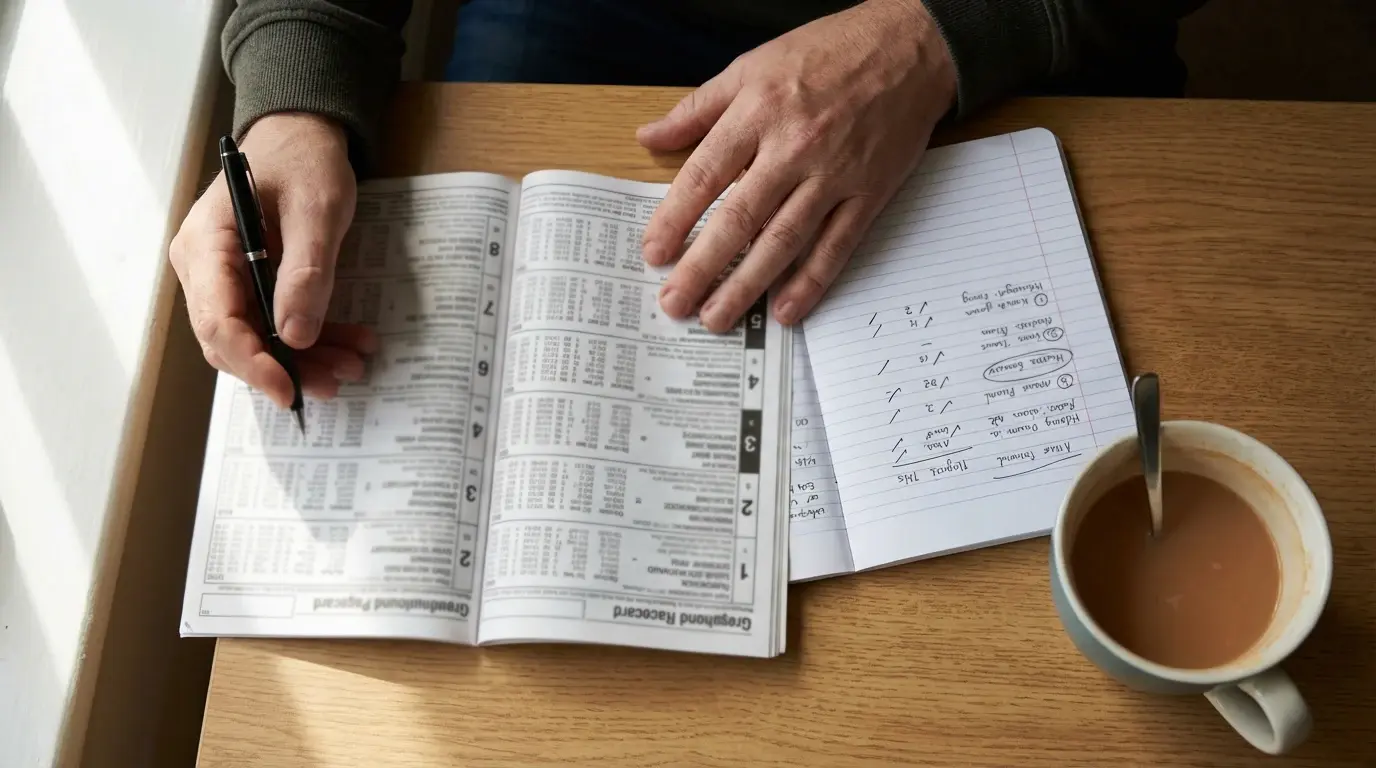
Consistent form analysis starts with a consistent process. That sounds pedestrian, but it’s the one thing that separates punters who improve over time from those who stay stuck at the same level. If you approach each racecard differently — sometimes checking sectional times, sometimes skipping them; sometimes reading running comments, sometimes just glancing at finishing positions — your analysis will be uneven and your results will reflect it. A fixed routine doesn’t guarantee winners, but it guarantees that every selection is produced by the same standard of scrutiny.
What to Look at First on Any Card
Start with the trap draw and recent form at the specific track. Before you read anything else about a dog, check whether it has run from this trap at this venue before, and what happened. A dog with three wins from four runs in trap two at Romford is a fundamentally different proposition than a dog debuting from that box at this track. Track-and-trap form is the single most predictive combination of variables on the racecard because it controls for venue-specific factors that affect every other piece of data.
Next, read the last three form lines in full — not just the finishing positions, but the positional sequences and running comments. You’re building a picture of how the dog runs: does it lead, does it close, does it get into trouble at the bends? Three runs is enough to identify a pattern without being so many that outdated form distorts the picture. If all three runs tell the same story — consistent early pace, clean runs, competitive finishes — the dog’s current profile is clear. If the three runs are wildly inconsistent, that’s a signal too: something is changing, and you need to decide whether the direction is positive or negative.
After form, check the time figures against the other runners at the same distance. The fastest recent time in the race isn’t always the best guide, because it might have been recorded under different conditions or from a more favourable trap. But a dog whose best recent time is two lengths faster than anything else in the field has a quantified advantage that the form alone might not make obvious.
Red Flags: When Form Is Misleading
Form figures tell you what happened, not why. A dog with two consecutive wins looks excellent on the surface, but if both wins came from trap one in weak graded races and the dog is now stepping up in class from a wide trap, those wins are less transferable than they appear. Grade changes are one of the most common form traps. A dog winning at A5 level is not necessarily competitive at A3, even if its recent form reads brilliantly. The opposition is stronger, the times are faster, and the margin for error shrinks.
Long absences are another red flag. A dog that hasn’t raced in four weeks or more may be returning from injury, illness, or season absence, and its last form may not reflect its current condition. Some racecards note the reason for absence; most don’t. If you see a gap between runs with no trial times listed, approach the dog’s form with scepticism unless you have additional information from a source like the trainer’s public comments or a racecard analyst’s notes.
Surface and going changes also deserve attention. A dog whose impressive form was all recorded on fast going may not reproduce those times on a slow, wet surface. This is easy to overlook because the going designation sits quietly in the form line, but it can transform a dog’s performance level. Check the going for each recent run and compare it to the conditions expected tonight. If there’s a significant mismatch, adjust your expectations downward for dogs that have only proven themselves on contrasting ground.
Trap Bias and Track-Specific Angles
Every track has a bias — the question is whether it’s big enough to bet on. Trap bias refers to the tendency of certain starting positions to produce more winners than others at a specific venue, and it exists because of the physical geometry of the track: the distance from traps to the first bend, the tightness of the bends, and the width of the running surface all create structural advantages for certain positions.
At tight tracks where the traps are close to the first bend, inside positions (traps one and two) tend to produce a higher win percentage because dogs drawn there reach the bend first and take the shortest route around it. At wider tracks with a longer run to the first turn, the advantage diminishes because all six dogs have more room to find their position before the bend arrives. The bias is real in aggregate — pool thousands of results from any UK track and the numbers will show it — but the magnitude varies from venue to venue, and at some tracks it’s statistically marginal.
The practical question for punters is not whether trap bias exists but whether it’s large enough to influence individual bet selections. At Romford, the inside-trap advantage is well-documented and significant enough to factor into every race assessment. At a wider track like Sheffield, the advantage is smaller and can be overridden by other factors like form and running style. Applying a blanket “always back trap one” rule across all tracks is crude and unprofitable. Applying trap-bias data at the specific track where it’s most pronounced is a different proposition entirely.
Track-specific angles extend beyond trap position. Some venues favour front-runners because the first bend comes early and dogs that lead there rarely get caught. Others reward closers because the long home straight gives late-running dogs a genuine opportunity to overhaul the leaders. Some tracks produce consistently fast times on dry evenings and visibly slower cards after rain. These patterns are observable in the data, and they add granularity to your form analysis that generic racecard reading misses.
The way to use track-specific data is as a filter, not a system. Once you’ve assessed each dog’s form, times, and running style, overlay the track context: does the trap suit this dog’s style at this venue? Does the distance and bend configuration favour the way it runs? Is the likely pace of the race — based on how many front-runners are drawn inside — consistent with your selection’s best chances? These are secondary questions, but they refine your primary analysis and occasionally change your final selection. A dog that looks best on pure form might drop behind a rival that’s better suited to the track’s specific demands. That distinction is worth making.
Staking Plans for Greyhound Betting
Your staking plan decides whether a winning strategy actually makes money. That sounds paradoxical, but it’s a mathematical reality. You can have a positive-expectation selection method — picking dogs whose true probability exceeds the odds — and still lose money if your staking is erratic. Conversely, a disciplined staking plan limits the damage during losing runs and maximises the return during winning ones, even if your selection ability is only slightly above average.
Level Staking vs Proportional Staking
Level staking is the simplest approach: you bet the same amount on every selection, regardless of the odds or your confidence level. If your unit stake is five pounds, every bet is five pounds. The appeal is total simplicity — there’s no calculation, no second-guessing, and no risk of overcommitting on a single race. Level staking also makes it easy to track performance, because your profit or loss is directly proportional to your strike rate and average odds.
The weakness of level staking is that it treats every bet as equally confident, which they rarely are. If you’ve identified a strong value bet at 4/1 and a marginal edge at 7/1, level staking puts the same money on both. A more nuanced approach would allocate more to the higher-confidence selection. That’s the argument for proportional staking, where the size of each bet is adjusted based on the perceived edge or the confidence level of the selection.
Proportional staking methods range from simple (bet more on shorter-priced selections, less on longer ones) to mathematically sophisticated (Kelly criterion, which calculates the optimal stake as a fraction of your bankroll based on the estimated edge). For most greyhound punters, a modified proportional approach works well: set a standard stake as your baseline, and allow yourself to increase it by a fixed increment — say, 50 percent — on selections where your confidence is highest. Don’t go beyond that. The moment stakes become emotionally driven rather than process-driven, the staking plan stops being a plan and becomes a gamble within a gamble.
Managing Variance in Small Fields
Greyhound racing’s six-dog fields create a specific variance profile that’s worth understanding. In a six-runner race, the favourite wins roughly 30 to 35 percent of the time at typical odds. That means even the market’s most likely outcome fails two-thirds of the time. Losing streaks of five, eight, or even twelve bets in succession are not unusual for a profitable punter betting at average odds of 3/1 — they’re statistically expected.
The emotional challenge of a losing streak is significant, and it’s where most staking plans get abandoned. A punter on a run of seven consecutive losers feels pressure to increase stakes to recover losses quickly, which is the single most destructive behaviour in betting. Chasing losses by raising stakes turns a manageable drawdown into a bankroll-threatening crisis. The staking plan exists precisely to prevent this. If your plan says five pounds per bet, the eighth bet after seven losers is still five pounds. The plan doesn’t change because the results have been bad.
One practical technique for managing variance is setting a session loss limit — a maximum amount you’re prepared to lose in a single meeting before stopping. If you reach the limit, you stop betting for the night regardless of how many races remain. This isn’t a staking plan in itself, but it provides a circuit breaker that prevents the worst-case scenario: a bad run compounded by escalating stakes and emotional decision-making. A session limit of four or five losing bets keeps you in control even when the results don’t cooperate.
Bankroll Management for the Dogs
A bankroll isn’t spare cash — it’s your working capital. The distinction changes how you think about every bet you place. Spare cash is money you can afford to lose. A bankroll is money you’re deploying strategically with the expectation of a return, which means it needs to be managed with the same discipline you’d apply to any other working fund.
The first step is defining the bankroll. Set aside a specific sum that is separate from your everyday finances — money that, if lost entirely, would not affect your bills, savings, or quality of life. That’s a non-negotiable starting condition. If the bankroll is built from money you need for rent, groceries, or debt payments, you’re not betting. You’re gambling with your security, and no strategy can compensate for that structural problem.
Once the bankroll is defined, the next decision is unit size — the standard stake that represents one betting unit. A common guideline is to set one unit at 1 to 2 percent of the total bankroll. If your bankroll is five hundred pounds, one unit is five to ten pounds. This ratio gives you enough runway to absorb losing streaks without depleting the fund. A punter betting 10 percent of their bankroll per race needs only ten consecutive losers — well within normal variance — to lose their entire stake. At 2 percent per bet, ten losers in a row costs 20 percent of the bankroll, which is a setback but not a catastrophe.
Bankroll management also means adjusting to results over time. If your bankroll grows through successful betting, your unit size can increase proportionally to maintain the same percentage ratio. If the bankroll shrinks, the unit size should decrease. This self-correcting mechanism protects you during drawdowns and allows you to capitalise during profitable periods. It requires regular review — checking your bankroll balance every week or fortnight and recalculating the unit — but that review takes two minutes and is some of the most valuable time you’ll spend.
The emotional dimension of bankroll management is at least as important as the mathematical one. A bankroll that’s too small relative to your betting frequency creates constant anxiety: every loss feels threatening, and every win feels essential. That emotional pressure leads to poor decisions — escalating stakes after setbacks, over-committing on perceived certainties, and abandoning the analytical process in favour of impulsive punts. A well-sized bankroll removes that pressure. It gives you the freedom to lose individual bets without panic, which is precisely the mental state you need to make clear-headed selections.
Greyhound racing’s daily fixture schedule makes bankroll management more important than in sports with weekly or fortnightly events. The temptation to bet every day is structural — there’s always a meeting, always a card, always an opportunity. Without a bankroll framework that limits your daily exposure and your per-bet stake, that daily availability can erode a fund far faster than the punter realises. Set the bankroll. Set the unit. Set a session limit. Then bet within those boundaries every single time.
When to Bet and When to Watch
Not every race on the card deserves your money. A twelve-race meeting might contain three races where your analysis produces a clear view and nine where it doesn’t. Betting on all twelve because you’re at the track or because the app is open on your phone is the fastest way to dilute whatever edge your form analysis provides. The races you sit out are as important as the races you bet on.
Selectivity starts before the meeting begins. When the racecards are published — usually several hours before the first race — scan the full card and identify which races are worth detailed analysis. Look for races where the form picture is relatively clear: dogs with consistent recent runs at this track, over this distance, from a trap they’ve used before. Skip races where half the field is returning from long absences, where dogs are running at a new distance, or where the form is so jumbled that any selection would be speculative.
During BAGS meetings, which can feature twelve to fourteen races across an afternoon, the temptation to bet on every race is amplified by the pace. Each race finishes, the next card appears, and the cycle repeats every fifteen minutes. The rhythm is designed to keep money flowing, and it works — most casual punters bet on far more races than their analysis justifies. Breaking that rhythm requires a deliberate decision: set a number of bets for the session in advance and don’t exceed it. Three to four bets per meeting is a reasonable target for most punters. That leaves you with eight to ten races where you simply watch, observe, and learn without risking a penny.
Watching without betting has a hidden benefit beyond bankroll preservation: it trains your eye. When you observe a race with no stake on the outcome, you notice details that emotional involvement obscures. How the traps opened, how the bends unfolded, which dogs gained or lost ground — these observations feed directly into your analysis for future meetings at the same track. The punter who watches fifty races and bets on ten will understand a track’s dynamics far better than the one who bets on all fifty and is too preoccupied with the results to see the patterns.
Tracking Your Bets: Why Records Matter
If you don’t record your bets, you don’t know if your strategy works. Memory is unreliable — punters overremember winners and underremember losers, which creates a distorted picture of performance that can sustain losing behaviour for months. A written record, whether in a spreadsheet or a dedicated tracking app, gives you the actual numbers: total bets, strike rate, average odds, profit or loss by track, by bet type, and over time.
The minimum data to record for each bet is: date, track, race number, dog name, trap, bet type, odds taken, stake, and result. That’s nine fields. Adding the dog’s finishing position, the running comment, and whether the race was BAGS or evening/weekend adds context that helps you review patterns later. The whole process takes about thirty seconds per bet. Over a month of regular betting, it produces a dataset that tells you more about your performance than any amount of subjective reflection.
What you learn from tracking is often surprising. Punters who feel they’re breaking even frequently discover they’re losing. Punters who feel they do best on Saturday evenings sometimes find their actual edge is in Wednesday BAGS meetings. Common discoveries include: a positive record at one or two tracks offset by losses at several others, suggesting the punter should narrow their focus; a better strike rate on win bets than forecasts, suggesting the selection skill is sound but the bet type is diluting it; or a pattern of over-staking late in sessions after losses, confirming that the staking plan breaks down under emotional pressure.
Tracking also provides the evidence base for refining your strategy. If your records show a 25 percent strike rate on selections at 3/1 or better at Romford, you know you’re profitable at that track and can justify increasing your activity there. If your records show a 15 percent strike rate at the same odds at Crayford, you know something isn’t translating and can investigate why. Without records, these insights are invisible. You’re navigating by feel, and feel is unreliable.
The discipline of recording every bet also has a psychological benefit: it forces you to be accountable to yourself. When you know every bet will be logged and reviewed, you’re less likely to place impulsive, unjustified wagers. The record becomes a mirror that reflects your actual behaviour rather than the version you’d prefer to believe in. That accountability, more than any analytical technique, is what turns recreational betting into a structured pursuit.
The Long Game: Why Patience Beats Instinct at the Dogs
The sharp greyhound punter isn’t the one with the best tips — it’s the one with the longest spreadsheet. That’s not a joke. It’s a description of what sustainable greyhound betting looks like in practice: hundreds of carefully selected bets, each recorded and reviewed, producing a cumulative picture of performance that either justifies continuing or signals a need to adjust.
Instinct has a role in betting — experienced punters develop a feel for races that’s hard to articulate but genuinely useful — but instinct without structure is just guessing with confidence. The punters who rely on gut feelings alone rarely track their results, which means they never discover whether those feelings are accurate. The ones who combine intuition with process — using instinct to flag opportunities and then subjecting those opportunities to analytical scrutiny — are the ones who last.
Greyhound racing is uniquely suited to the long-game approach because the volume of racing is so high. With fixtures running daily across twenty venues, the sample size builds faster than in almost any other betting sport. A punter who bets selectively — three or four times per session, two or three sessions per week — can accumulate over five hundred recorded bets in a year. That’s a statistically meaningful sample from which genuine patterns can be drawn: which tracks produce your best results, which bet types are most profitable, which analytical habits correlate with winners.
The long game demands patience through drawdowns, discipline during winning streaks, and the willingness to trust the process even when short-term results are discouraging. It’s not exciting. It’s not glamorous. It doesn’t produce the stories people tell at the pub. But it produces something better: a clear, evidence-based understanding of whether your approach works, and the data to improve it if it doesn’t. In a sport where the traps open every quarter of an hour and the temptation to act is constant, the ability to slow down, think clearly, and bet only when the evidence supports it is the most underrated advantage available.