

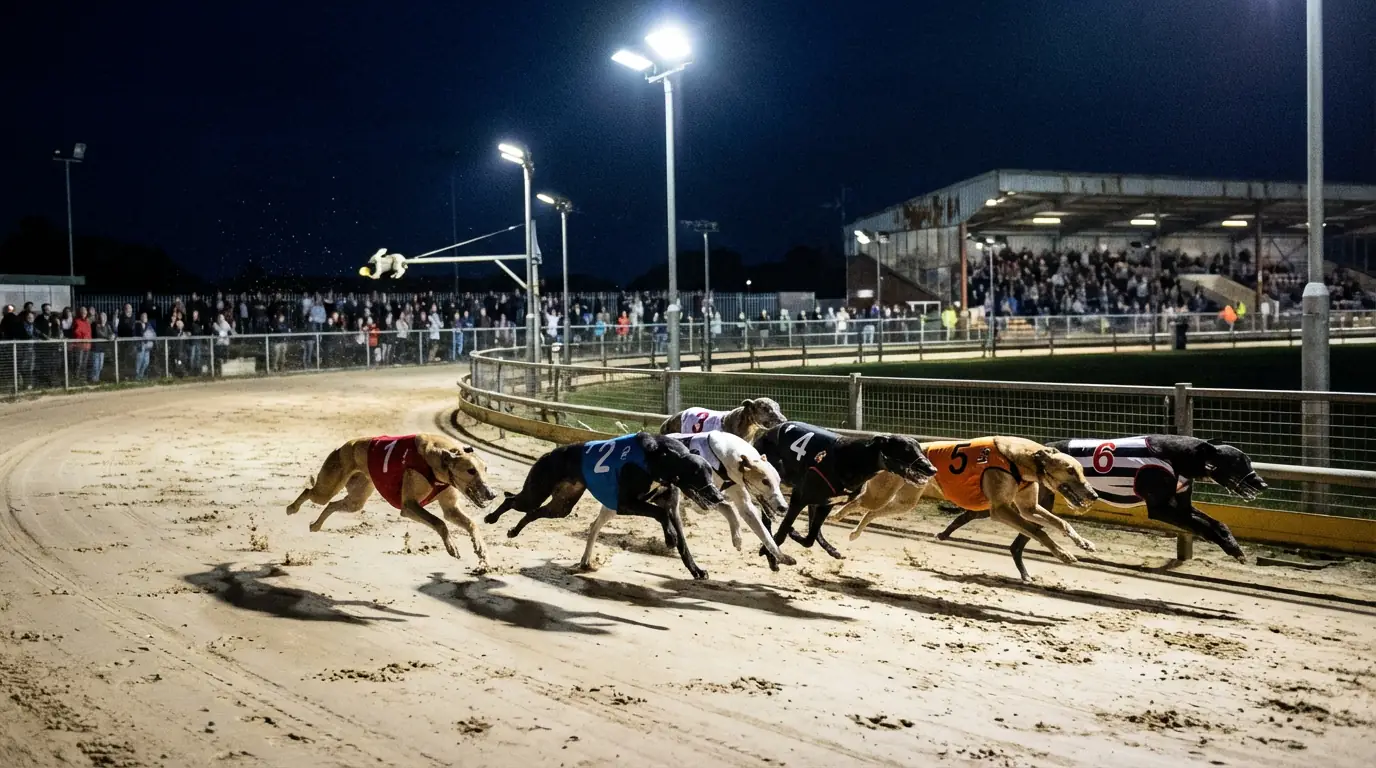
What Greyhound Fixtures Are and Why They Matter to Punters
Every greyhound fixture in the UK follows a specific logic — and if you can read it, you can bet sharper. That is the entire premise of this guide. Not a glossy overview of a sport you already know exists, but a working document for anyone who wants to move beyond picking trap numbers at random and start treating greyhound betting the way it deserves: as a skill built on structure, data, and preparation.
A greyhound fixture is a scheduled race meeting at a licensed stadium. It contains a set number of races, each with its own racecard, its own set of runners, its own betting market. The UK runs fixtures almost every day of the year, across 18 GBGB-licensed stadiums from Newcastle in the north to Brighton and Hove on the south coast. That volume is both the sport's appeal and its trap. With so many meetings available, punters who don't understand how fixtures are structured, how racecards work, or how odds behave in six-dog fields are essentially donating money to the bookmakers' bottom line.
This guide covers the full anatomy of a greyhound fixture: from the two-tier racing system that governs the weekly calendar, through racecard reading and bet types, to track-by-track insights, form analysis, and the seasonal rhythm of UK greyhound racing. Whether you're placing your first bet on the dogs or sharpening an existing approach, the information here is designed to give you a structural advantage — one built on understanding rather than luck.
UK GREYHOUND FIXTURES AT A GLANCE
The UK's 18 licensed stadiums collectively stage around 900 race meetings per year, producing over 70,000 individual races annually. Fixtures run seven days a week, split between daytime BAGS meetings for the betting shop market and evening or weekend Premier fixtures with higher prize money and stronger fields. In 2026, the GBGB's open race calendar features 50 category one competitions and 27 category twos — the most comprehensive schedule in recent memory.
How UK Greyhound Fixtures Are Structured
The skeleton of a UK greyhound fixture list isn't random. It is a commercially driven schedule designed to serve two distinct audiences — and understanding that split is the first step toward betting more effectively on the dogs.
UK greyhound racing operates on a two-tier system. The backbone is BAGS racing.
BAGS racing — the Bookmakers' Afternoon Greyhound Service, a programme of daytime meetings that supplies live content to licensed betting shops and online sportsbooks, typically Monday to Saturday.
BAGS meetings generate the majority of races in any given week and are responsible for the steady turnover that sustains most stadiums financially. Prize money is lower, fields include dogs at a wider range of grades, and the atmosphere is functional rather than glamorous. But for punters, BAGS offers something valuable: volume, familiarity, and the chance to build knowledge at specific tracks over many meetings.
The second tier is Premier Greyhound Racing, covering evening and weekend meetings at selected stadiums. Premier fixtures carry higher prize money, attract stronger fields, and host the sport's showcase competitions. If BAGS is the bread and butter, Premier is the steak dinner.
How BAGS and Premier Racing Split the Weekly Calendar
Monday through Saturday, BAGS fixtures dominate the daytime schedule, with meetings starting from around 10:30 or 11:00 and running through to late afternoon. Multiple tracks stage BAGS meetings simultaneously, so a punter might have three or four meetings to choose from at any given hour.
Premier meetings take over in the evening — typically from around 18:00 or 19:00 — and tend to concentrate on Thursday, Friday, and Saturday nights. Some stadiums run both a BAGS afternoon card and a Premier evening card on the same day. Sundays see a mix of afternoon and early evening meetings.
The result is an almost continuous supply of racing across the week. The sharper approach is to specialise in a handful of tracks where you can build genuine knowledge of the dogs, trainers, and track characteristics rather than spreading your betting across every available meeting.
Fixture Frequency: How Many Races Run Each Week
Each meeting typically comprises 12 to 14 races. Across all 18 licensed stadiums, the weekly total of individual races comfortably exceeds 1,000 during normal operation. That volume is staggering compared to horse racing and is one of the reasons greyhound betting appeals to punters who want frequent, fast-turnaround action.
Race intervals are tight — typically eight to twelve minutes between races. A full BAGS card of 14 races runs in around two and a half hours. This pace suits the sport's core audience but demands discipline: the rapid-fire nature means losses can accumulate quickly for anyone betting without a plan.
Reading a Greyhound Racecard for Any Fixture
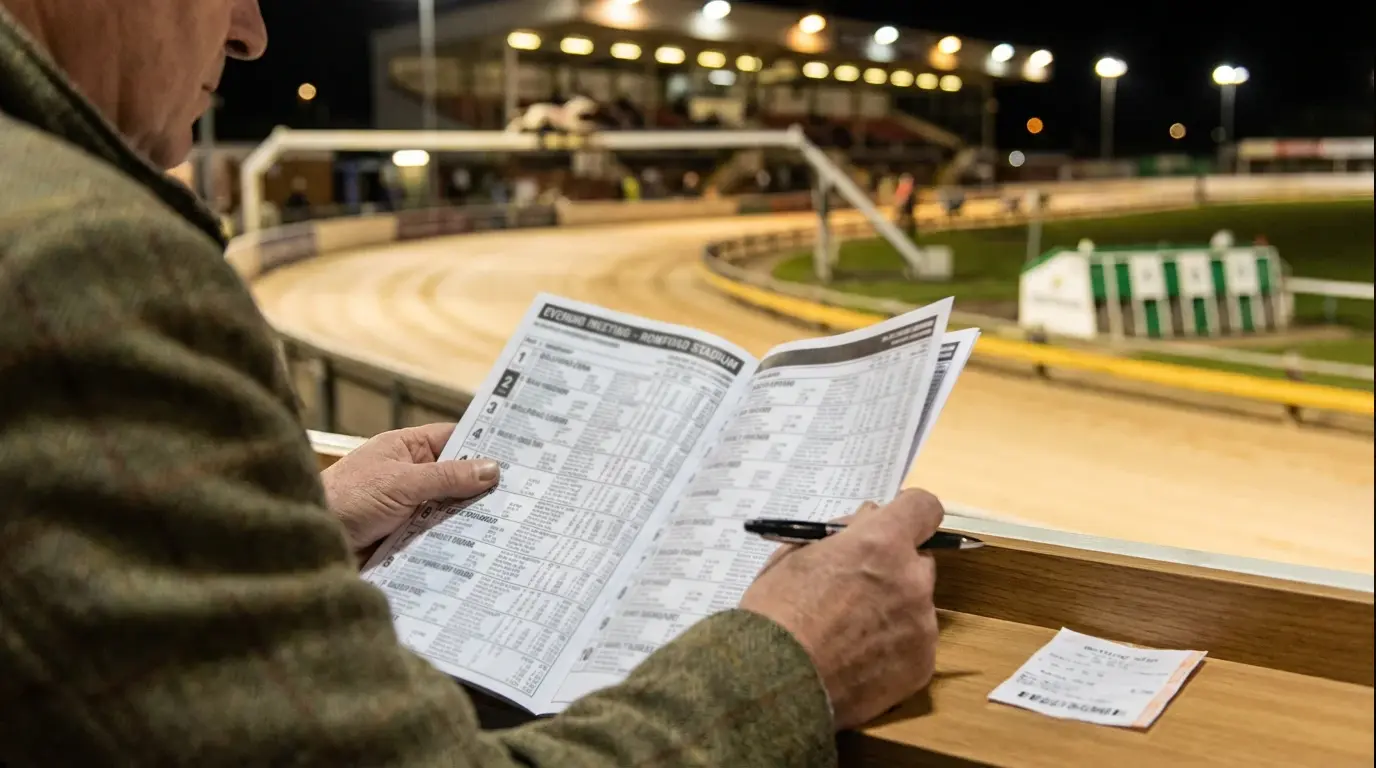
A racecard is a compressed biography of every runner. It tells you where the dog has been, how it ran, what happened along the way, and who prepared it. Learning to read this information fluently is not optional — it is the difference between making a selection and making a guess.
Every racecard at a UK greyhound fixture follows the same basic template, whether you're looking at a BAGS meeting at Romford on a Wednesday afternoon or a Premier card at Towcester on a Saturday night. The format is standardised, but the depth of what it reveals depends entirely on how well you know what you're looking at.
Form Figures, Trap History, and Sectional Times
The form figures are the most information-dense element on any racecard. They read as a sequence of numbers and letters representing the dog's recent races — typically the last six runs. Each line encodes the trap drawn, the dog's position at key points in the race (first bend, second bend, third bend where applicable, and finishing position), the winning distance or distance beaten, the calculated time, and the going (track condition).
A form line might read something like this: 3-2-1-1 by 2.5 lengths, 29.43, Normal. That tells you the dog broke from trap three, was second at the first bend, moved to the lead by the second bend, and won by two and a half lengths in a time of 29.43 seconds on a normal running surface. Each of those data points carries meaning. The trap position tells you where the dog has been drawn before. The positional numbers reveal whether it tends to lead early or finish strongly. The time gives you a raw speed benchmark, and the going tells you what surface conditions it has performed on.
Sectional times — typically a split to the first bend and a run-home time — add another layer. Two dogs might post identical overall times through entirely different running styles. A dog reaching the first bend in 4.50 seconds and running home in 15.80 is a completely different proposition from one going through in 4.80 but coming home in 15.50. The first needs the lead; the second wants a clear run late. Sectional data separates front-runners from closers in a way that finishing positions alone cannot.
Trap history per track is equally important. A dog's record from a specific trap at a specific venue tells you far more than its overall win rate. A dog that wins readily from trap one at a galloping track like Towcester might struggle from the same position at a tighter circuit where early crowding is more likely.
SAMPLE RACECARD ENTRY
| Trap | Dog | Form | Trainer | Best Time | Odds |
|---|---|---|---|---|---|
| 1 (Red) | Ballymac Doyle | 1111 | L. Dowling | 28.67 | 5/4 |
| 2 (Blue) | Swift Renegade | 3212 | K. Hutton | 28.85 | 3/1 |
| 3 (White) | Deerjet Mabel | 5431 | P. Janssens | 29.02 | 7/1 |
| 4 (Black) | Droopys Donut | 2124 | M. Wallis | 28.91 | 4/1 |
| 5 (Orange) | Kilara Legend | 4345 | D. Childs | 29.10 | 12/1 |
| 6 (Stripes) | Romeo Magico | 6653 | S. Maplesden | 29.15 | 10/1 |
Trap 1 shows consistent front-running form (1111). Trap 6 has been slow away and wide — the improving form (6653) suggests a dog coming to hand, but it needs a trouble-free run from the outside draw. The market reflects this uncertainty: short-priced favourite versus a double-figure outsider.
Trainer and Kennel Data on the Card
Trainer information appears on every racecard and is one of the most underused angles in greyhound betting. Certain trainers have strong records at specific tracks, particularly those located near their kennels. A trainer who regularly sends dogs to Romford will know the track intimately — its first-bend crowding patterns, the distances that suit different styles, the effect of specific draws. That local knowledge translates into better preparation and, statistically, better results.
Kennel form — the overall recent strike rate of a trainer's runners — is also worth monitoring. A kennel in form tends to stay in form. Conversely, a trainer whose dogs have posted a string of poor results across several meetings might be dealing with illness or simply a spell of poor grading.
Weight and season status are final racecard details that deserve attention. Dogs are weighed before every race, and the weight is published on the card. Larger changes — more than a pound over several runs — can signal fitness issues or a change in training routine. Season status for bitches (marked with an "s" indicator) matters because a bitch approaching or returning from season can run erratically.
Greyhound Bet Types Available at Every Fixture
Six dogs, one race, and more than a dozen ways to bet on it. Greyhound racing might look simple from the outside — pick a dog, hope it wins — but the range of bet types available at every fixture gives punters far more flexibility than that. Understanding what each bet does, what it costs, and what it returns is fundamental to building a sustainable approach.
Singles, Each Way, and Place Bets
The win single is the simplest bet in greyhound racing. You pick one dog to finish first. If it wins, you collect at the agreed odds. If it doesn't, you lose your stake. Clean, straightforward, and the foundation of most punters' activity.
A place bet pays out if your selection finishes in the top two (for races with six runners under standard rules). The odds are lower than the win price, but the probability of collecting is obviously higher. Place betting makes most sense when you rate a dog to run well but aren't confident it will get to the front.
Each way is a combination of a win bet and a place bet, packaged as a single selection but charged as two stakes. If you bet two pounds each way, you are staking four pounds total — two on the win and two on the place. If the dog wins, both parts pay out. If it finishes second, only the place part pays, at a fraction of the win odds (typically one quarter in greyhound racing). Each-way betting works best at longer prices, where the place return alone can cover or exceed the total stake.
Forecasts, Tricasts, and Combination Bets
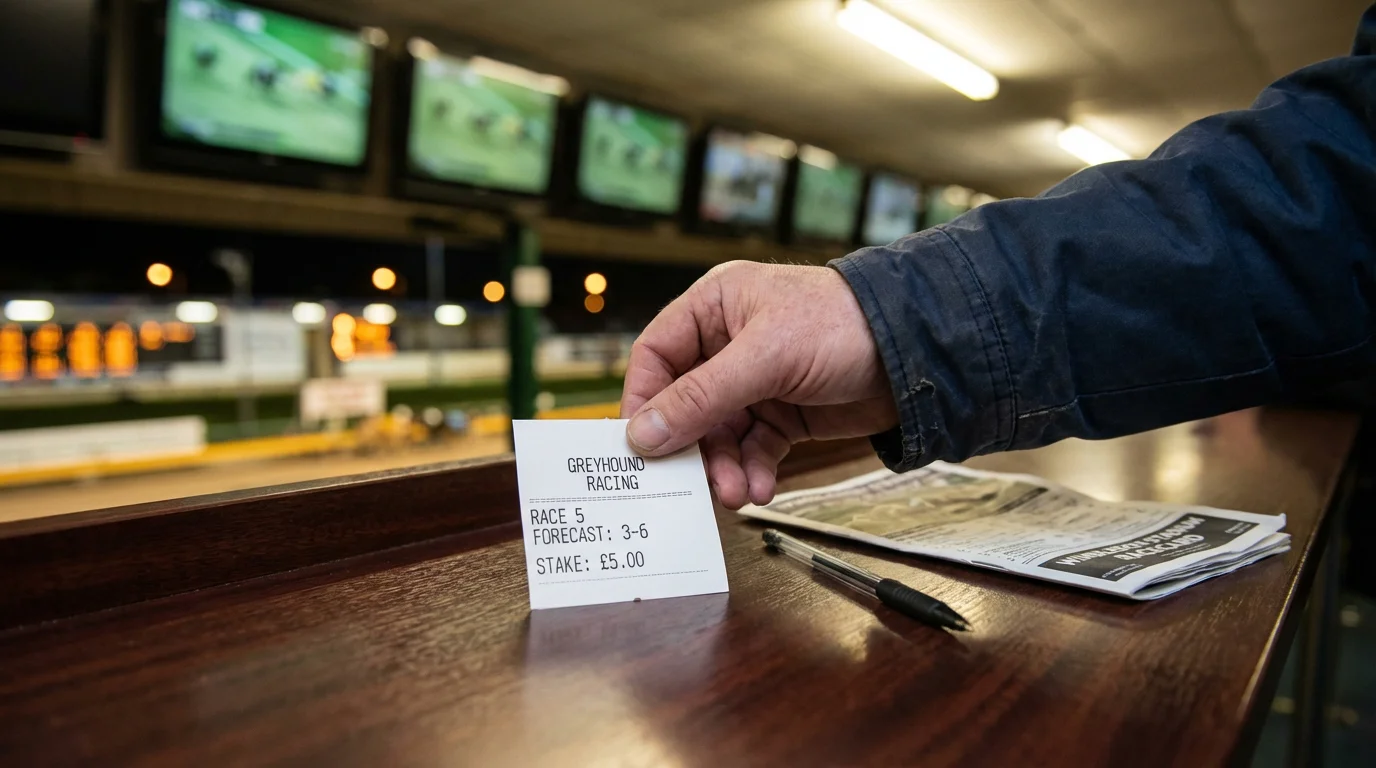
A straight forecast requires you to predict the first and second dog in the correct order. The payout is calculated by the tote pool or the bookmaker's own dividend, and because you are predicting two finishing positions, the returns can be significantly higher than a simple win bet. The catch is obvious: you need to get both positions right.
A reverse forecast covers both possible orderings of your two selections — Dog A first and Dog B second, or Dog B first and Dog A second. It costs twice the unit stake of a straight forecast but removes the need to pick the exact order. This is a sensible bet when you're confident two dogs will dominate the finish but unsure which will lead.
A combination forecast extends this logic to three or more selections, covering every possible first-second pairing among your chosen dogs. Three dogs produce six combinations; four produce twelve. Use it selectively, or the stake can erode the return.
The tricast requires predicting the first, second, and third dog in exact order. It is the highest-paying common bet type in greyhound racing, with dividends regularly running into three figures from a one-pound stake. A combination tricast covers all possible orderings of three or more selections into the first three positions. Three dogs give six combinations; four dogs give twenty-four. Tricasts reward deep form study — if you can genuinely eliminate three dogs from contention in a six-runner field, the maths starts to work in your favour.
WORKED EXAMPLE: STRAIGHT FORECAST CALCULATION
Race at Romford, 480m graded race. You believe Trap 2 (odds 3/1) will beat Trap 4 (odds 5/1) in a tight finish.
Stake: £2 straight forecast on Trap 2 first, Trap 4 second.
Forecast dividend declared: £27.40 to a £1 stake.
Your return: £2 x £27.40 = £54.80
If you placed a reverse forecast instead: £2 per combination x 2 combinations = £4 total stake. If the result comes in either order, you collect £27.40 x £2 = £54.80 (if your predicted order hits) or the reverse dividend (if the other order hits). The reverse forecast guarantees a payout if your two dogs fill the first two positions, at double the cost.
Accumulators and Multi-Race Bets
An accumulator links selections from multiple races into a single bet. All selections must win for the bet to pay out. The appeal is that the odds multiply — backing four dogs at 2/1 each in an accumulator produces combined odds of 80/1 from a small stake. The problem is that the probability of all four winning is genuinely low, and one losing leg wipes out the entire bet.
Accumulators have their place as small-stake, high-reward side bets alongside a disciplined single-bet strategy. But treating them as a primary method is a reliable way to bleed your bankroll. Even if each selection has a 40% chance of winning, a four-fold accumulator has only a 2.56% chance of landing.
A more disciplined variation is the trap challenge, sometimes offered by bookmakers as a special market. You select one trap number to produce the most winners across all races at a specific meeting. It's a novelty bet — there's no genuine skill involved — but some punters enjoy it as a low-stakes sideshow.
How Greyhound Odds Work: From Board Price to SP
Odds on greyhounds shift faster than in most sports. A horse racing market might stabilise an hour before the off; a greyhound market can swing violently in the final five minutes. Understanding why — and knowing when to take a price versus waiting — is one of the most practical edges a punter can develop.
Greyhound odds are initially set by bookmakers' traders based on their assessment of each dog's chance. These opening prices appear anywhere from 30 minutes to a few hours before the race. From that point, the odds move in response to the weight of money being bet. Heavy money on a particular dog shortens its odds; a lack of interest causes them to drift.
The six-runner field is what makes greyhound markets so volatile. In horse racing, a 16-runner handicap absorbs significant bets without wild swings. In a six-dog race, one large wager on the favourite can compress the entire market. This creates both opportunity and risk: you might spot a dog at a generous early price that you know will shorten, or you might take a price that drifts because smarter money is going elsewhere.
Starting Price vs Taking a Price
The starting price (SP) is the official odds of a dog at the moment the traps open. It is determined by an industry formula based on the prices available on-course at the track. If you place a bet and don't request specific odds, your bookmaker will settle at SP by default.
Taking a price — also known as accepting the board price — means locking in the odds displayed at the moment you place your bet, regardless of how they move before the race. This is where skill enters the equation. If you believe a dog is overpriced in the early market, taking the board price locks in that value. If the dog's odds subsequently shorten to half the price you took, you've gained a significant edge.
The flipside is that prices can drift too. If you take 3/1 on a dog that opens at 3/1 and drifts to 5/1 by the off, you've locked in worse odds than SP would have given you. The general principle among experienced punters is straightforward: take the price early when you believe the dog is underestimated by the market, and wait for SP when you expect the price to drift or when you have no strong view on the likely market movement.
Best Odds Guaranteed and When It Applies
Best odds guaranteed (BOG) is a promotion offered by many major UK bookmakers that eliminates the risk of taking an early price. Under BOG terms, if you take a board price and the starting price turns out to be higher, the bookmaker pays you at the better odds. In effect, it removes the downside of early price-taking while preserving the upside.
Not all bookmakers offer BOG on greyhound racing. Those that do sometimes restrict it to specific meetings or bet types (usually win singles), or cap the maximum stake. Check which bookmakers include greyhound BOG in their standard terms, because on days when it's available, there is almost no reason to bet at SP.
Market compression in small fields
Be cautious when the market collapses around a heavy favourite. In a six-runner race, a dog trading at 1/3 means the bookmaker's market gives it an implied probability of around 75%. The remaining five dogs share the other 25%. In these races, the favourite may well win — but the odds offer almost no reward for the risk. If it loses, the market has already priced the other runners at odds that rarely reflect their true chance. In short-priced favourite races, the forecast and tricast markets often offer better risk-adjusted value than the win market.
UK Greyhound Racing Tracks: Where Fixtures Are Held
Eighteen licensed stadiums — each with its own personality. The dimensions of the track, the sharpness of the bends, the length of the run to the first turn, and the surface condition all vary from venue to venue. A dog that dominates at one track can struggle at another, and understanding these differences is one of the most practical edges available to a punter who takes fixture selection seriously.
All GBGB-licensed tracks use sand surfaces, and all run over distances ranging from short sprints (around 210 to 280 metres) through standard distances (400 to 500 metres) up to stayers' trips (630 metres and beyond). But within those parameters, the variation is considerable.
Major Tracks and Their Signature Distances
Towcester
Home of the English Greyhound Derby. A large, galloping track that suits long-striding dogs. Standard distances of 480m and 500m (the latter used for the Derby) with a sweeping run to the first bend that rewards early pace without the crowding issues of tighter circuits. Races six days a week.
Nottingham
One of the premier venues in the Midlands. A well-maintained track with standard distances of 300m, 480m, 500m, and stayers' trips up to 922m. Known for strong graded racing and a calendar that includes several category one open competitions.
Romford
London's busiest greyhound venue. A tight, sharp track where early pace and a clean first bend are critical. The 400m trip is the bread-and-butter distance. Romford's compact dimensions mean trap position carries more weight here than at larger circuits.
Hove
Brighton and Hove stadium is one of the longest-established tracks in British greyhound racing. A wide circuit with distances from 285m to 970m. Its spacious layout tends to suit wide-running dogs and reduce first-bend interference.
Sheffield
Owlerton Stadium is Yorkshire's flagship greyhound venue. A fair, well-balanced track that doesn't heavily favour inside or outside runners. Distances range from 280m sprints to 500m standard races and stayers' trips up to 934m. Hosts the Sheffield Steel City Cup among other open events.
Newcastle
The most northerly licensed track in England. Newcastle's long straights and sweeping bends produce fair racing, and the venue has recently invested in facility upgrades. Hosts the All England Cup and serves as a key fixture in the northern racing circuit.
What to Expect From Different Venues
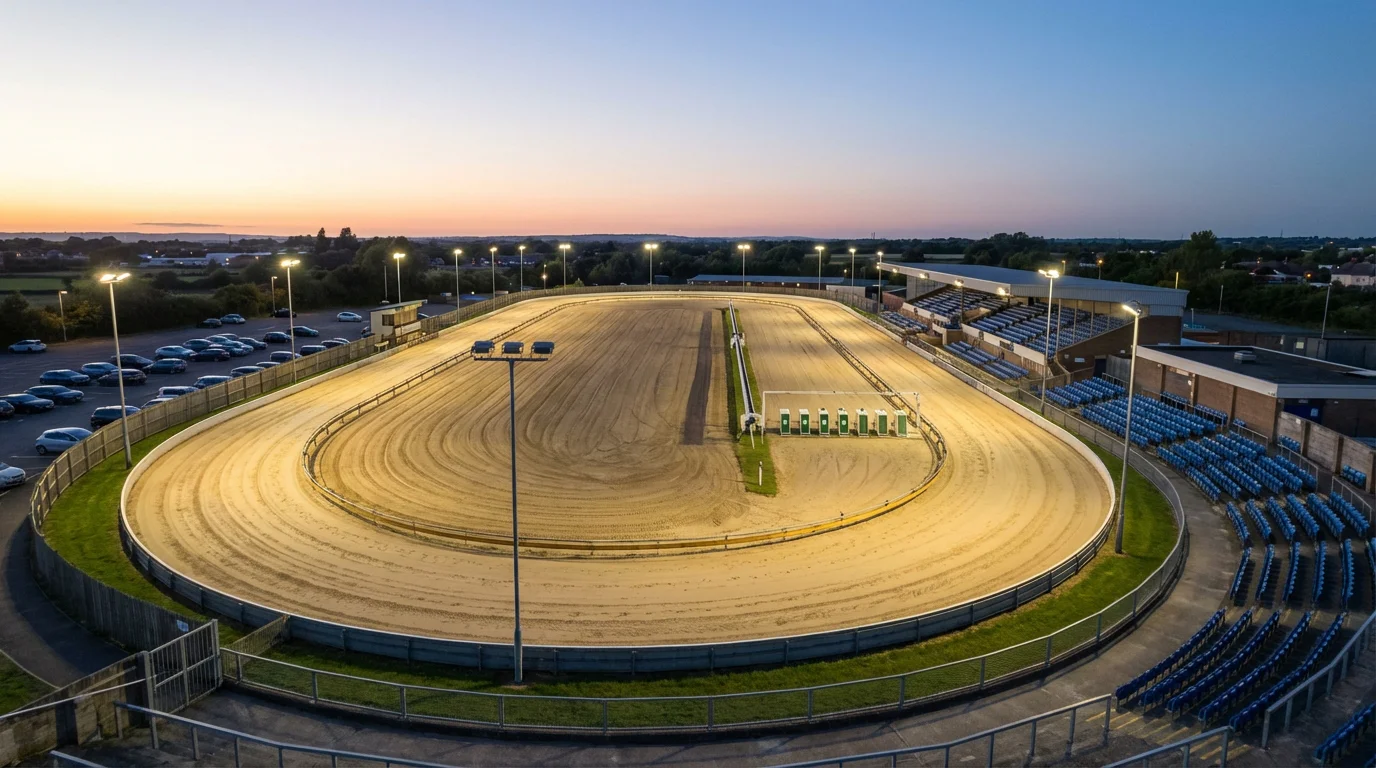
Track shape is the single biggest variable between venues. A track with a short run to the first bend — like Romford — creates more early crowding, which penalises dogs drawn on the outside and rewards those with early pace from inside traps. A track with a long run-up — like Towcester or Hove — gives every runner more time to find position before the first bend, reducing the impact of trap draw and placing greater emphasis on raw speed.
Bend tightness matters too. Tight bends suit dogs that can hold a rail position through the turn. Wide, sweeping bends allow dogs to maintain speed from any position, which is why wide-running dogs tend to perform better at larger circuits. If you're betting on a dog that habitually runs wide, check the track dimensions before you commit.
Beyond the physical track, different venues attract different standards of competition. Stadiums that host major open races draw top-class dogs from across the country. Others primarily serve their local trainer population. A dog winning graded races at a competitive stadium is making a different statement than one winning at a track with thinner fields.
Trap Draw and Running Styles: Tactical Factors at Every Meeting
Trap one isn't always the best draw — and trap six isn't always doomed. The relationship between trap position and race outcomes is a genuine variable that affects results, but the reality is more nuanced than the broad-brush statistics suggest.
Does Trap Position Really Affect Outcomes?
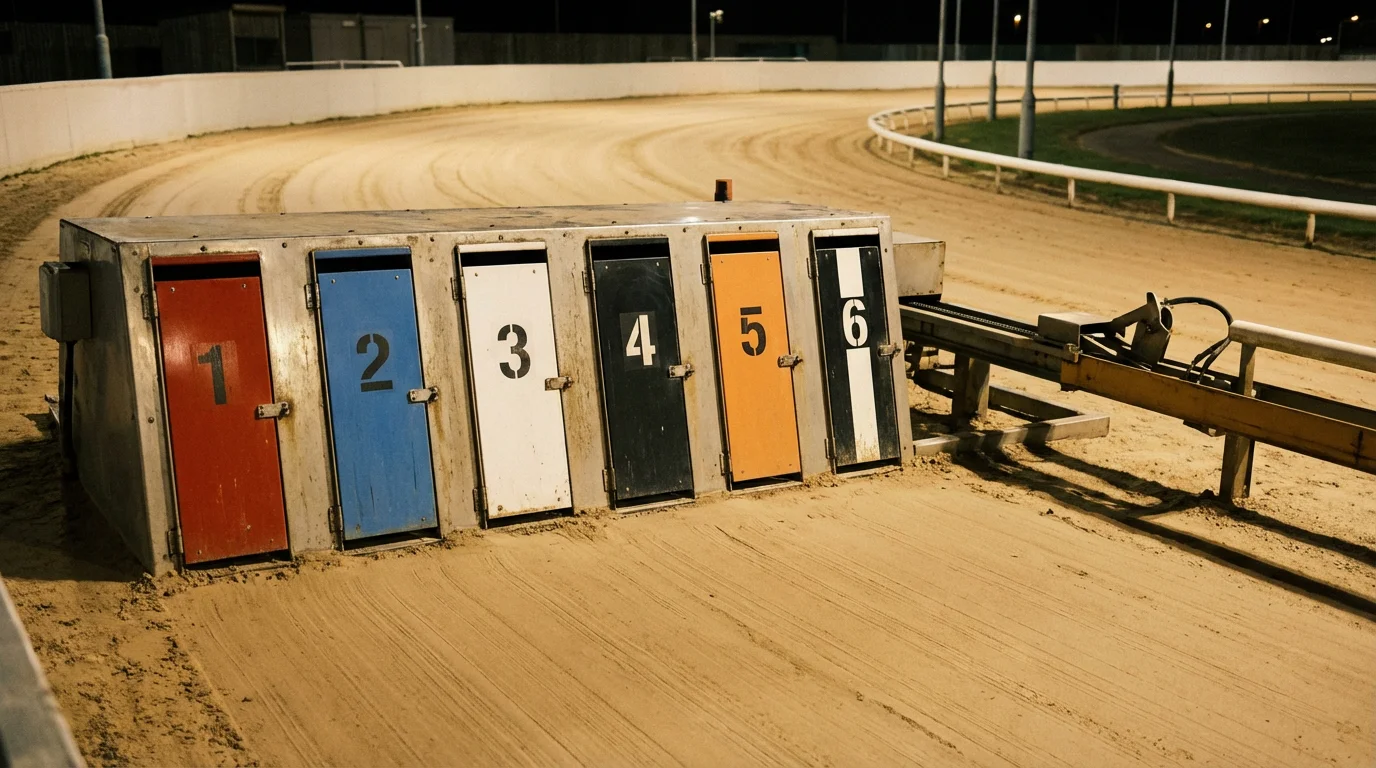
Across all UK tracks, inside traps (one, two, and three) produce a higher percentage of winners than outside traps (four, five, and six). That is an observable fact, consistent over years of data. The reason is mechanical: the hare runs on the inside rail, and dogs breaking from inside traps have a shorter path to the first bend. They are less likely to be crowded, less likely to check (slow down due to interference), and more likely to lead at the crucial first-turn point.
UK Fixtures Betting Toolkit
Three tools built from the guide’s own trap-bias data, staking guidance, and board-price mechanics.
National data: inside traps (1–3) combine for a 55–58% win share, outside traps (4–6) for 42–45%. Tight-bend tracks like Romford tend to exaggerate this split; wide, galloping tracks like Towcester and Hove narrow it. Use this as a sense check against the market price, not a standalone prediction.
With around 1,000+ UK greyhound races running every week and a new race every 8–12 minutes, it is easy to drift into far more bets than planned. This splits your weekly budget across the fixtures and bets you actually intend to make, and flags if your chosen stake percentage would blow through it.
Taking a board price locks in that profit regardless of how the market moves. Without Best Odds Guaranteed, you keep the board-price profit even if the starting price drifts higher — but you also miss the upside. With BOG, you are always paid the better of the two.
But the degree of inside-trap advantage varies enormously by track. At Romford, where the run to the first bend is short and the bends are tight, trap one's win rate is markedly higher than the track average. At Towcester, where the run-up is long and the bends sweep gently, the gap between inside and outside traps narrows considerably. Some tracks — Sheffield being a notable example — produce relatively balanced statistics across all six positions because the track geometry doesn't heavily penalise any draw.
Inside Traps: 1, 2, 3
- Shorter path to the first bend
- Less exposure to early crowding
- Natural rail position through the first turn
- Suit railers and early-pace dogs
- Combined win rate across UK tracks: approximately 55-58%
Outside Traps: 4, 5, 6
- Longer path to the first bend
- More vulnerable to first-bend interference
- Need to run wider through the first turn
- Suit wide runners and strong finishers
- Combined win rate across UK tracks: approximately 42-45%
The key point for punters is that aggregate statistics obscure track-specific realities. If you're betting at a specific venue, the only data that matters is the trap bias at that venue, over that distance, in recent meetings. National averages are a starting point, not a verdict.
Railers, Wide Runners, and Early Pace
Every greyhound has a natural running style revealed by the racecard's positional data through the bends. A railer hugs the inside rail through the turns and benefits from inside draws where it can find the rail immediately. A railer drawn in trap five or six faces a problem: it needs to work across the field, risking interference and lost ground.
A wide runner takes the opposite approach, racing around the outside of the field through the turns. Wide runners are less affected by crowding at the first bend but cover more ground on every turn. They need raw speed or a strong finishing kick to compensate for the extra distance. A wide runner drawn in trap one is poorly placed — it either has to break slowly to find room to get wide, or it leads and gets taken on by dogs running to its outside.
Early-pace dogs — front-runners that break sharply and lead from the traps — are the most trap-sensitive category. A front-runner needs to reach the first bend in front or close to it. From trap one, that's straightforward. From trap six, it requires exceptional break speed and a generous run-up. The interaction between running style and trap draw is where the real analytical work happens. A dog with strong form drawn in the wrong trap for its style is a different proposition from the same dog drawn where it wants to be.
Greyhound Racing Calendar: Seasonal Fixtures and Key Dates
The greyhound calendar doesn't sleep — but it does have peaks. Fixtures run virtually every day of the year at UK stadiums, but the rhythm of competition, the quality of fields, and the conditions underfoot all shift with the seasons. Knowing when the major events fall and how the calendar's tempo changes is useful both for planning your betting activity and for understanding why form can appear inconsistent at certain times of year.
Major Competitions and Their Place in the Calendar
The centrepiece of the UK greyhound racing year is the English Greyhound Derby, held at Towcester and spread across six weeks from late April through to the final in early June. The 2026 Derby begins with first-round heats on 30 April and concludes with the final on 6 June — a timeline that transforms the spring calendar into the sport's most concentrated period of elite competition. With a first prize of £175,000, the Derby attracts the strongest greyhounds from across Britain and Ireland, and the quality of the supporting card makes each round night a premium betting fixture in its own right. The current hosting arrangement sees Towcester hold the event through 2026 under a five-year deal agreed by the GBGB.
The Greyhound St Leger typically runs in the autumn at a venue that has varied over the years, while the TV Trophy falls in the spring calendar at a leading Premier track. The GBGB's 2026 open race schedule — marking the centenary of organised greyhound racing in Britain — includes 50 category one competitions and 27 category twos spread across the calendar year. That schedule means there is at least one major open event almost every week during the core racing season, giving punters who follow the sport's elite tier a steady supply of high-quality betting fixtures.
Beyond the headline competitions, each stadium has its own local calendar of significant events. The Romford Champion Stakes, the Sheffield Steel City Cup, the Newcastle All England Cup, the Hove Gold Cup — these are regionally important fixtures that attract strong entries and generate competitive markets.
How Season and Weather Affect Fixtures
UK greyhound tracks are outdoor sand circuits, and weather has a tangible impact on racing. Heavy rain softens the surface, which slows times and affects dogs differently depending on their build and running style. Lighter, early-pace dogs tend to cope better with soft going than heavier, stamina-reliant types. Prolonged dry spells harden the surface, producing faster times but increasing the jarring effect on joints — something that can affect older dogs or those recovering from minor niggles.
Winter meetings occasionally face postponement due to frost or waterlogging, though the sand surfaces used at UK tracks are more weather-resistant than turf. The winter calendar tends to feature fewer open competitions and more graded racing, which suits punters who prefer the relative predictability of graded fields. Summer, by contrast, is competition season — the Derby period in particular sees unusually strong fields at open meetings, which can disrupt normal grading patterns as top dogs are redirected to the big events.
Do
- Track going conditions through recent results at your chosen venue before placing bets
- Adjust your speed expectations for heavy or soft going — raw times are misleading on affected surfaces
- Take advantage of the summer open competition season when form data on elite dogs is most plentiful
- Monitor the fixture calendar for clashes that might thin out graded fields at smaller tracks
Don't
- Assume dogs will replicate normal-going form on a rain-softened track without checking
- Overbake your betting during midweek BAGS cards just because racing is available — volume is not value
- Ignore the fact that grading can shift during major competition periods when top dogs are redirected elsewhere
- Treat winter form and summer form as directly comparable — surface and daylight conditions affect performance
Greyhound Form Analysis: Turning Data Into Decisions
Form isn't prediction. It's context. The racecard gives you raw data — positions, times, weights, grades. Form analysis is the process of interpreting that data in a way that identifies genuine contenders, exposes false favourites, and highlights dogs whose true ability is masked by superficial numbers.
What Recent Form Actually Tells You
The last six runs are the standard window of recent form in greyhound racing. But not all six runs carry equal weight. The most recent two or three outings are the most informative because greyhound form can shift quickly — a dog's fitness, confidence, and preparation can change meaningfully over the course of a few weeks.
Reading form starts with the finishing positions but goes deeper. A dog that finished third in its last run might look ordinary until you check the running comments and discover it was badly hampered at the first bend, recovered to third from last position, and posted a faster run-home sectional than the winner. That is a dog in good form, despite the bare result. Conversely, a dog that won its last start might have done so in a weak graded race against out-of-form opponents, making the victory less meaningful than it appears.
Class changes are another critical factor. When a dog moves up a grade after a win (promoted from, say, A4 to A3), it faces stronger opposition. Its form figures in the new grade are more revealing than anything it did at the lower level. Similarly, a dog dropping in grade — perhaps after a poor run or two — might be better than its recent results suggest if the drop brings it back to a level where it has previously performed well.
Trouble in running is the great equaliser in greyhound form. Because six dogs race together around tight bends at high speed, interference is common. A dog's form figures might show a string of mid-field finishes, but if each of those runs involved checking, crowding, or being forced wide, the underlying ability might be considerably higher than the numbers suggest. The running comments on the racecard — abbreviations like "CkBnd1" (checked at bend one), "Wide2" (ran wide at bend two), or "Bmp1" (bumped at the first bend) — are essential reading for anyone doing serious form analysis.
Weight Trends, Age, and Fitness Signals
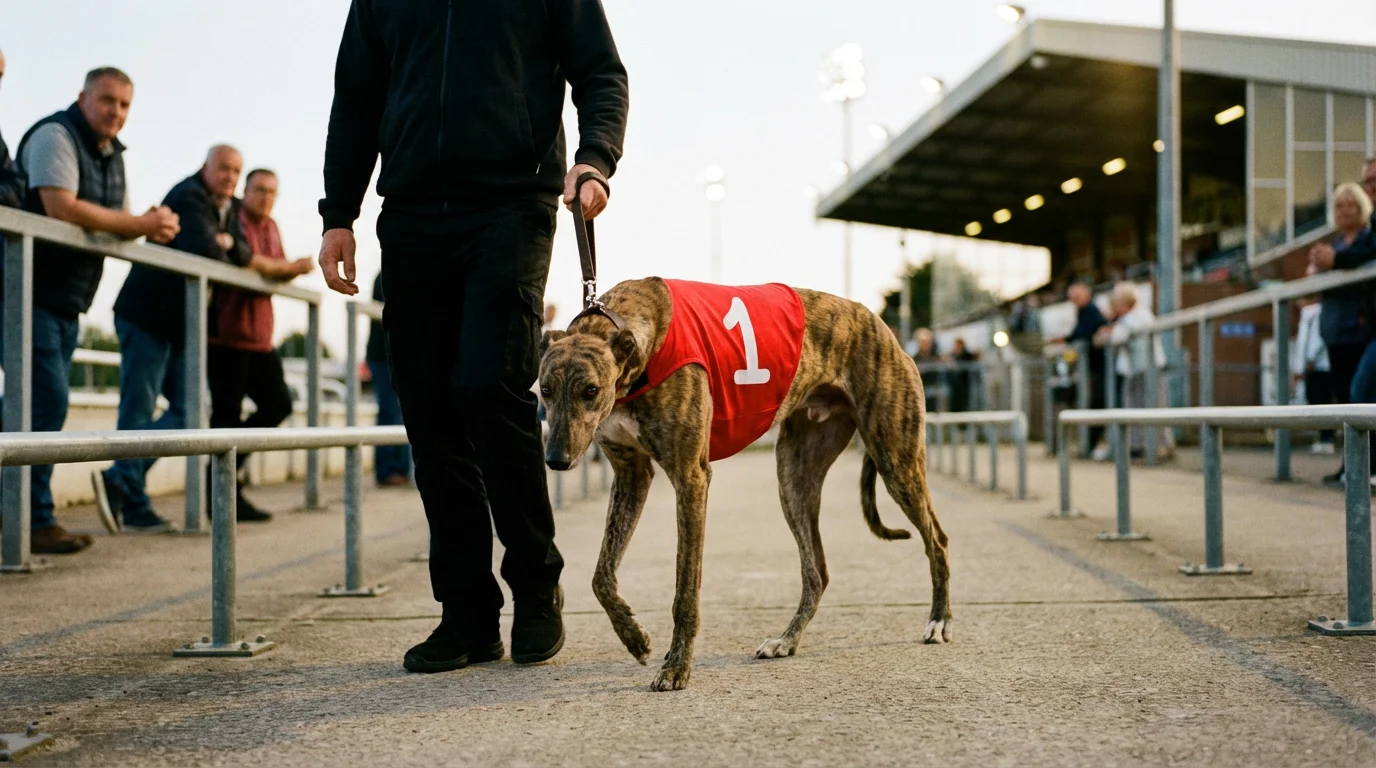
A greyhound's weight is recorded at every race. Small fluctuations of half a pound or less are normal. But a consistent upward or downward trend over three or four runs is a signal worth noting. A dog gaining weight steadily might be losing fitness. A dog losing weight might be sharpening up — or might be stressed and struggling. Context matters: a half-pound drop accompanied by improved finishing positions is likely positive. A full-pound drop with declining form is a warning.
Age matters more than many punters appreciate. Greyhounds peak between roughly two and four years old. A two-year-old might have raw talent but lack tactical awareness in crowded fields. A three-year-old in its prime combines physical maturity with racing experience. Once a dog passes four, the decline can be gradual or sudden — some race well into their fifth year, but speed and recovery ability typically diminish.
Finally, consider the gap between runs. A dog racing weekly is on a standard schedule. A dog absent for more than two weeks might be returning from a trial, a minor injury, or a kennel change. Dogs back from a break of more than 14 days deserve caution — their trial time gives some indication of readiness, but there is inherent uncertainty in any return to the track after an absence.
Form tells you where a dog has been. Trap, distance, and going tell you where it's going.
Live Streaming and Watching Greyhound Fixtures
You don't need to be trackside to follow the action. The majority of UK greyhound fixtures are available to watch live, either through bookmaker streaming services or through dedicated racing channels. For punters who base their decisions on form study rather than live observation, streaming is a valuable tool — watching races back helps you confirm or refine your interpretation of the racecard data.
Most major UK bookmakers offer live streaming of greyhound racing through their websites and mobile apps. The typical requirement is a funded betting account or a placed bet on the relevant meeting. Stream quality has improved significantly, and most now offer multi-camera coverage with trap colours, dog names, and real-time positions displayed on screen.
RPGTV — Racing Post Greyhound TV — is a free-to-air channel on Freeview and other platforms that broadcasts live greyhound racing from selected UK tracks most evenings, with expert analysis and racecard breakdowns. Sky Sports Racing also covers some fixtures, particularly Premier meetings and major open competitions.
Watching live racing — or replays — adds a dimension the racecard cannot. You can observe how a dog breaks, how it handles crowding, whether it finishes strongly, and how it behaves before the race. Experienced punters routinely watch replays of their selected dogs' previous runs before committing to a bet, particularly in open races where margins between dogs are tight.
Responsible Betting on Greyhound Fixtures
Greyhound racing runs every day. That makes bankroll discipline non-negotiable. The sheer volume of available fixtures — over 1,000 races per week — creates a constant temptation to bet, and the rapid-fire pace of individual meetings (a new race every eight to twelve minutes) means losses can escalate quickly for anyone without clear limits in place.
Every licensed UK bookmaker provides deposit limit tools that allow you to set daily, weekly, or monthly caps on the amount you can add to your account. Use them. Setting a deposit limit before you start is a more effective form of discipline than relying on willpower in the moment. Most bookmakers also offer loss limits, session time reminders, and cooling-off periods that temporarily suspend your ability to place bets.
If gambling is becoming a problem — if you find yourself chasing losses, betting with money you can't afford to lose, or feeling anxious about your betting activity — there are support services available. GambleAware provides free advice, information, and support for anyone affected by gambling. GamStop is the UK's national self-exclusion scheme, which allows you to block yourself from all UKGC-licensed gambling sites for a period of six months, one year, or five years.
The GBGB also maintains resources relating to the welfare of greyhounds and the integrity of the sport. Responsible betting includes betting on a sport you trust, and understanding the regulatory framework under which UK greyhound racing operates — licensed by the GBGB and overseen by the UK Gambling Commission — is part of that.
FAQ
How do I read a greyhound racecard?
A greyhound racecard displays each runner's trap number, name, trainer, recent form figures, best time at the track distance, and current weight. The form figures are a sequence showing the dog's position at key points during each of its recent races — typically the first bend, second bend, and finishing position, along with the distance won or beaten by, the calculated time, and the going (track condition). Sectional times, where published, break the race into a time to the first bend and a run-home time, revealing whether the dog is an early-pace type or a strong finisher. Weight changes between runs can signal fitness shifts, and trainer details help you identify kennel form patterns. Reading the racecard fluently takes practice, but the core skill is learning to look beyond the finishing positions and into the detail of how each run unfolded.
What is the best trap position in greyhound racing?
Inside traps — particularly trap one and trap two — produce the highest overall win percentages across UK tracks, with the three inside positions (traps one to three) collectively accounting for approximately 55 to 58 percent of winners. The advantage comes from a shorter path to the first bend and less exposure to early crowding. However, the degree of inside-trap bias varies significantly between tracks. At venues with a short run to the first bend, such as Romford, the inside advantage is pronounced. At larger, more galloping tracks like Towcester or Hove, the gap between inside and outside positions narrows. The best approach is to check trap statistics at the specific track and distance you're betting on rather than relying on national averages. A dog's running style also matters — a natural wide runner drawn inside can be just as disadvantaged as a railer drawn in trap six.
How are greyhound racing odds calculated?
Greyhound odds are set initially by bookmakers' traders, who assess each dog's chance of winning based on recent form, trap draw, track record, and kennel form. These opening prices are then adjusted in response to betting activity — when money comes in on a specific dog, its odds shorten, and the odds on the other runners lengthen. The starting price (SP) is determined at the moment the traps open, based on the on-course market. Because greyhound races feature only six runners, the markets are significantly more volatile than horse racing: a single large bet can move the entire field's odds. Punters can either take the board price at the time of betting (locking in the displayed odds) or accept SP. Taking the board price is advantageous when you believe the dog is underestimated early; accepting SP is safer when you expect the odds to drift.
After the Last Trap: What Separates Sharp Punters From the Crowd
The fixtures will still be there tomorrow — the question is whether you'll approach them differently. Every greyhound meeting at every licensed UK stadium is built on the same structure: six dogs, a racecard, a set of odds, and a result. The information is the same for everyone. The difference between casual punters who pick a name and sharp bettors who read the fixture is one of preparation.
Preparation means knowing the track and its trap bias. It means reading form figures beyond the finishing position. It means understanding that a dog's weight change over three runs, its sectional time profile, and its trainer's recent strike rate all carry information that the headline odds don't fully capture. It means recognising that a forecast or tricast in a compressed market can offer better value than a win bet on a short-priced favourite. It means accepting that not every fixture and not every race deserves a bet — that discipline and selectivity are as important as analysis.
UK greyhound racing is a sport that rewards those who do the work before the traps open. The calendar runs year-round, the data is freely available, and the markets are liquid enough to find genuine value for anyone willing to put in the hours. This guide has given you the structural framework. What you do with it at the next meeting is entirely up to you.
