Best Greyhound Betting Sites – Bet on Greyhounds in 2026
Loading...
The Race That Defines a Generation
The English Greyhound Derby is the single biggest race on the UK greyhound calendar. It carries more prestige, more prize money, and more betting interest than any other event in the sport. For trainers, winning the Derby is a career-defining achievement. For punters, it’s the one greyhound race that draws attention from people who wouldn’t normally watch a dog run around a sand track on a Tuesday afternoon.
The Derby has been contested since 1927, making it nearly a century old (Towcester Racecourse — Derby Past Winners). In that time, it has moved between venues, survived world wars, weathered the decline of greyhound racing as a mass-spectator sport, and emerged in the modern era as the competition that still commands genuine respect. It’s the race that connects the sport’s past to its present — and the one that every serious greyhound punter should understand before the heats begin.
Derby History and Prestige
The first English Greyhound Derby was run at White City in London in 1927, just one year after the introduction of modern greyhound racing to Britain at Belle Vue in Manchester (Greyhound Racing UK — History of the Sport). The race captured the public imagination immediately. Greyhound racing was the new working-class spectator sport, and the Derby became its showpiece — the equivalent of the Epsom Derby for the dogs.
White City hosted the Derby for decades before the competition moved to Wimbledon in 1985, following White City’s closure in 1984 (Towcester Racecourse — Derby Past Winners). Wimbledon became the spiritual home of the Derby for a generation of fans and punters, hosting the event from 1985 until 2016. The stadium itself closed in March 2017 (Greyhound Racing Times — London Wimbledon). The race then moved to Towcester in 2017, switched to Nottingham in 2019 after Towcester Racecourse closed in 2018, and returned to Towcester in 2021 where it has been staged since (Greyhound Racing UK — History of the Sport). Each venue change has altered the character of the competition — different track sizes, different bend configurations, different atmospheres — but the prestige has remained constant.
The Derby’s significance extends beyond the final itself. The qualifying process — a series of heats and semi-finals staged over several weeks — creates a narrative arc that builds anticipation throughout the late spring. Dogs that looked impressive in February start to be discussed as potential Derby contenders. By April, ante post markets open. By May, the heats are underway, and the sport’s attention narrows to the 100-plus entries vying for a place in the final.
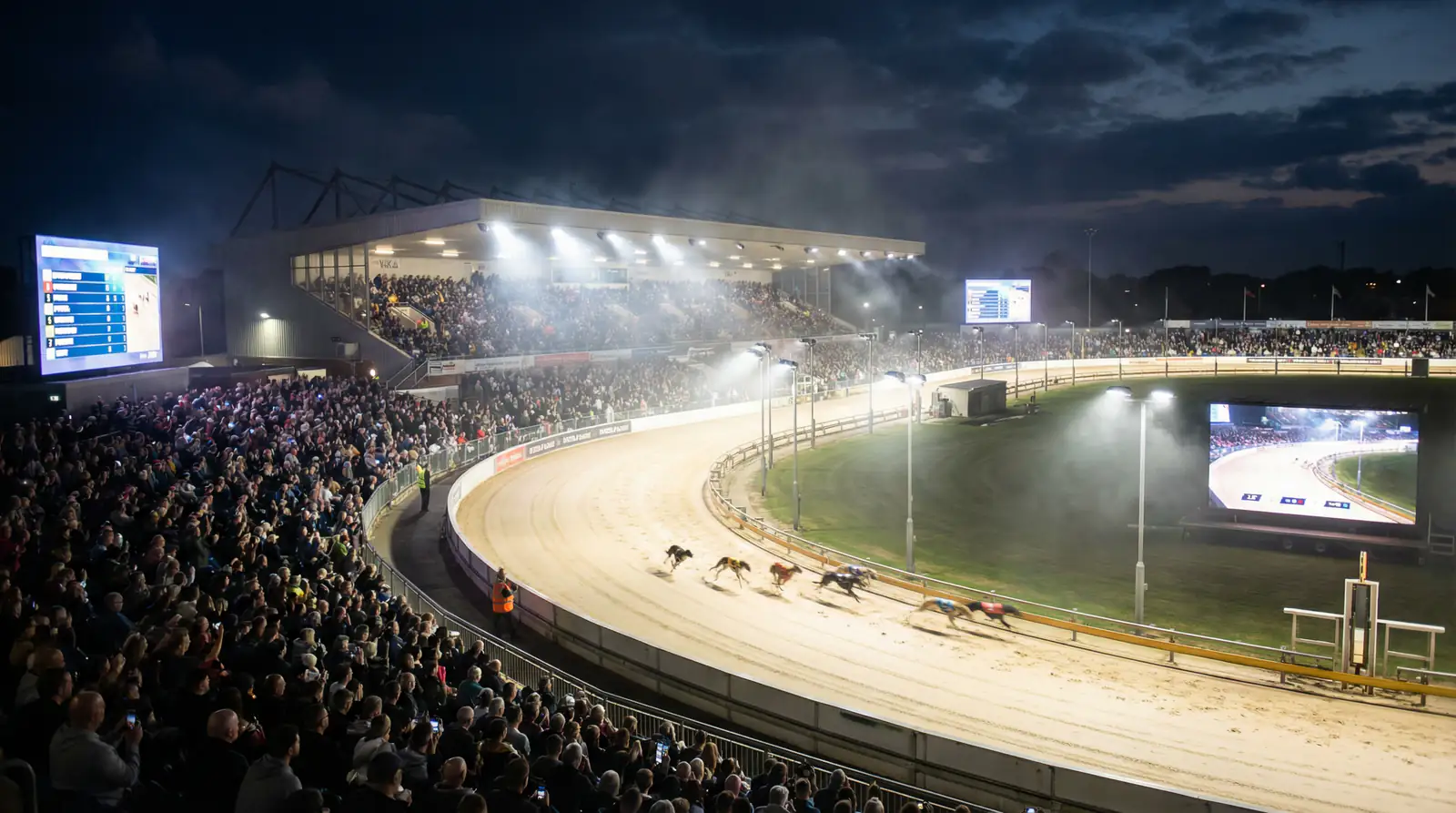
Prize money reflects the event’s status. The Derby final carries the largest first prize in UK greyhound racing, dwarfing the rewards available in standard open races. That prize money attracts the best dogs from across the UK and Ireland, ensuring the final fields represent the highest quality the sport can produce in any given year. When the Derby final takes place on a Saturday evening in June, the six dogs in the traps are, by consensus, among the best racing greyhounds alive.
The competition also matters for breeding. A Derby winner’s pedigree becomes a selling point for future generations. Sire lines that produce Derby winners command higher stud fees, and trainers target their best-bred youngsters at the competition years in advance. The Derby shapes the sport’s genetics as much as its calendar.
Format: Heats, Semi-Finals, Final
The Derby is not a single race — it’s a tournament. The format runs across several weeks, with multiple rounds of elimination reducing the field from over 100 entries to the six dogs that contest the final.
The opening round consists of first-round heats. Entries are drawn into heats of six, and the top two finishers in each heat progress to the next round. The heat draw is conducted publicly, and it can significantly influence a dog’s path through the competition. A favourable heat — drawn against weaker opposition — gives a dog a better chance of qualifying without expending maximum effort. A tough heat might eliminate a genuine contender before the semi-finals.
Second-round heats follow the same structure: six dogs per heat, top two qualify. By this stage, the weakest entries have been eliminated, and the quality of racing tightens considerably. The second round is often where ante post prices shift most dramatically, as dogs that looked impressive in the first round confirm their credentials or fall short against stiffer opposition.
The semi-finals are the penultimate stage. Typically two semi-finals of six runners, with the top three from each semi progressing to the final — though the exact format can vary slightly depending on the number of entries and the organiser’s structure. Semi-final night is one of the most compelling evenings in the greyhound calendar. The six qualifiers for the final are decided, and the market for the final itself forms rapidly as punters assess the semi-final performances.
The final is a single race: six dogs, one winner, maximum stakes. The trap draw for the final is conducted after the semi-finals, and it can reshape the betting market overnight. A strong favourite drawn in trap six might drift, while a contender with a perfect trap-draw for its running style might shorten significantly. The final is the one greyhound race of the year where the market is deep enough and liquid enough for serious money to flow, and the odds reflect genuine analytical depth from the betting public.
How to Bet on the Greyhound Derby
The Derby offers betting opportunities at every stage — ante post before the heats begin, heat-by-heat during the qualifying rounds, and outright on the final itself. Each stage demands a different approach.
Ante post betting opens weeks before the first heat. Prices at this stage are speculative, based on dogs’ open-race form during the spring and their general reputation. The value in ante post markets comes from identifying contenders that the wider market hasn’t focused on yet — dogs that have been running well at lower-profile meetings or that have the ideal profile (early pace, good trap record, proven over the Derby distance) without the headline results that attract mainstream attention.
The risk of ante post betting is that your selection might not make the final. Injury, poor draws, and unexpected defeats in the heats can eliminate any dog. Ante post stakes are typically non-refundable — if your dog doesn’t reach the final, your bet is lost. This risk is priced into the odds, which is why ante post prices are often significantly longer than the on-the-day odds for the same dog. Whether that risk premium represents value depends on how confident you are in the dog’s ability to survive the heats.
During the heats, you can bet on individual races or continue to back dogs outright for the final. Heat betting is similar to standard graded racing, though the quality is higher and the fields are less familiar — dogs from different tracks meeting for the first time. Watch the heats carefully, even the ones you don’t have bets on. The way a dog wins its heat — comfortably from the front, or closing from behind after trouble — tells you a lot about its prospects in later rounds.
For the final itself, the market is the most liquid and most analysed of any greyhound race all year. Finding value is harder because so many people are studying the same six dogs. Your edge, if you have one, comes from the accumulated knowledge built across the heats and semis — having watched every round, noted running styles, identified which dogs handled adversity well, and assessed which trap draw favours which runner. The final rewards depth of engagement over casual interest.
Memorable Derby Moments
The Derby’s long history has produced enough dramatic finishes, unlikely winners, and record-breaking performances to fill a book. Certain moments stand out for their impact on the sport and on the betting public’s imagination.
Trap draws that reshuffled the market overnight have been a recurring theme. The Derby final’s trap draw is a separate event, and it produces moments of elation and despair depending on which dog lands which position. A strong favourite drawn in trap one — the statistically favourable inside position — can shorten from 2/1 to 6/4 in minutes. The same dog drawn in trap six might drift to 3/1 or longer, creating sudden value for punters who fancy the favourite’s rivals.
Shock results have punctuated the Derby regularly enough to keep the betting public honest. Dogs that drifted to 10/1 or longer in the final betting have won the Derby more than once, rewarding punters who backed their own analysis against the weight of market opinion. These results are reminders that the Derby final, for all its prestige, is still a six-dog greyhound race where anything can happen at the first bend.
Repeat winners and trainer dynasties have added layers of narrative to the competition. Certain trainers have dominated the Derby across multiple decades, their kennels producing finalist after finalist through a combination of breeding skill, preparation quality, and race management. Following these kennels in the build-up to the Derby — tracking their open-race form through the spring — is one of the most reliable ways to identify contenders before the ante post market fully forms. The Derby rewards those who treat it as a season-long project rather than a single night’s punt.