Best Greyhound Betting Sites – Bet on Greyhounds in 2026
Loading...
Two Prices, One Race, Different Outcomes
Every greyhound race generates two sets of odds that matter to the bettor: the board price and the starting price. The board price is what the bookmaker offers when the market first opens — the number you see on screen when you’re studying the racecard and deciding whether to bet. The starting price is what the odds settle at when the traps open. Between those two moments, the market moves, and the price your bet is settled at can make a meaningful difference to your returns.
Most punters don’t think about this distinction. They open the app, see a price, bet on it, and move on. But the decision of when to take a price — early or late — is a genuine strategic choice in greyhound betting, and it’s one that becomes more consequential in the thin, volatile markets that characterise greyhound racing compared to horse racing or football.
Understanding the relationship between SP and board price, and knowing when each works in your favour, is a small edge. Small edges, applied consistently, are what separate profitable punters from the rest.
What Is Starting Price?
The starting price is the official odds of a greyhound at the moment the traps open. It’s determined by the on-course market — the prices being offered by bookmakers at the track — and represents the final assessment of each dog’s chances before the race begins. If you place a bet at SP (which you can do explicitly with most bookmakers), your payout is calculated using whatever the starting price turns out to be, regardless of what the odds were when you placed the bet.
In practice, the SP is set by an independent assessor who observes the on-course market and records a representative price for each runner. This process has been standard in British racing for decades and provides a benchmark that all bookmakers use for settling SP bets. The SP is published immediately after each race and is available through all major form services.
For the bettor, SP is a safety net of sorts. If you can’t decide whether the current price represents value, or if you suspect the market might move but aren’t sure which direction, betting at SP means you’ll get whatever the market settles at. You avoid the risk of locking in a price that subsequently drifts to much better odds, though you also forfeit the chance to lock in a price that shortens before the off.
The critical nuance is that SP reflects all the money that enters the market up to the start of the race. It incorporates the opinions of professional punters, stable connections, and track regulars whose bets are placed in the final minutes. SP is, in theory, the most informationally efficient price — the one that reflects the widest range of knowledge. Whether that makes it the best price to take is a different question entirely.
What Is Board Price / Early Price?
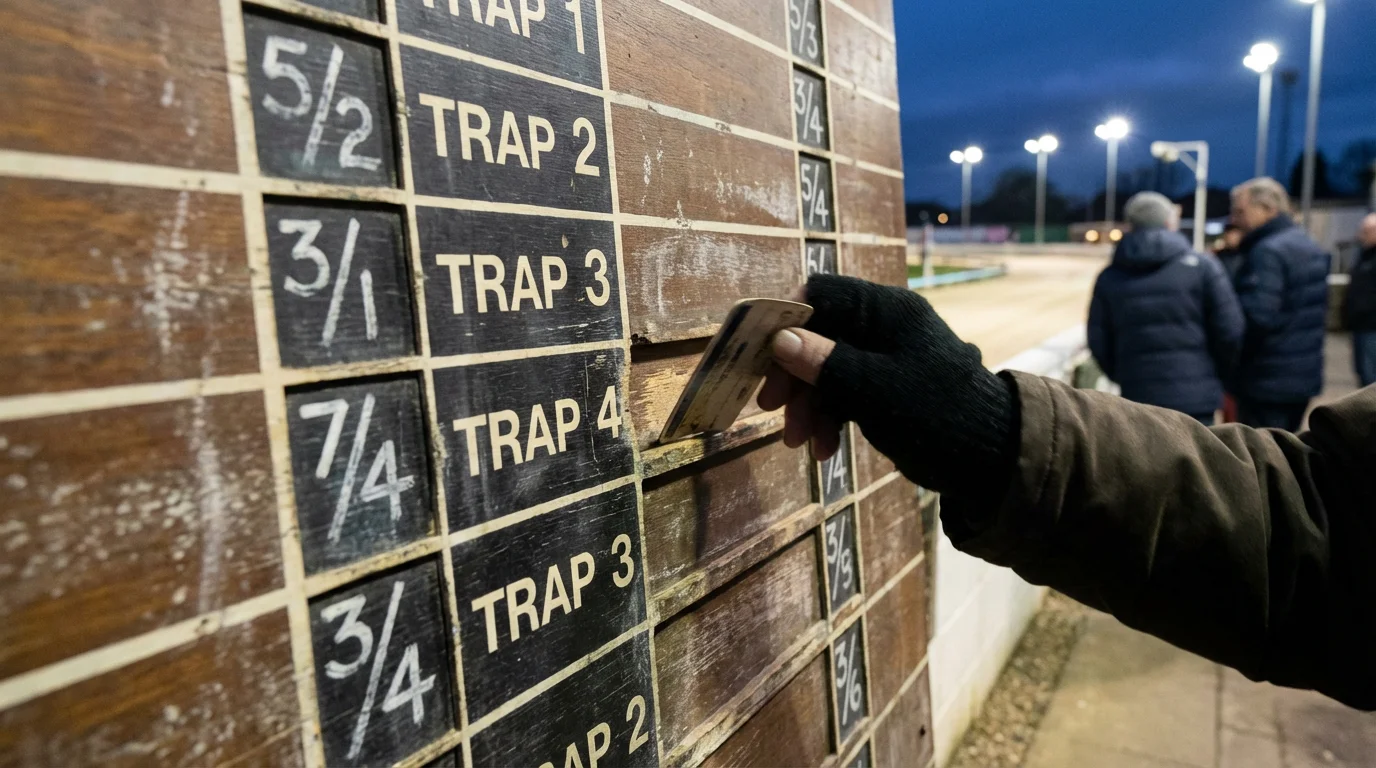
The board price — sometimes called the early price or ante-post price on the day — is the odds a bookmaker offers from the moment the market opens for a race. For greyhound racing, this typically means prices are available from mid-morning for afternoon BAGS meetings and from the early afternoon for evening fixtures. These prices are set by the bookmaker’s traders using their own form assessment, and they represent an opening estimate of each dog’s chances.
When you take a board price, you’re locking in those odds for your bet. If the price subsequently shortens — because money comes in on the dog from other bettors — you’ve secured a better price than anyone who bets later. If the price drifts — because the market moves against the dog — you’ve locked in a worse price than the SP will offer. This is the fundamental trade-off of early betting.
Board prices in greyhound racing tend to be set with wider margins than SP. Bookmakers build in extra margin to protect themselves against early money from informed bettors who may know something the market hasn’t priced in yet. This means board prices can sometimes undervalue or overvalue specific dogs — and those pricing errors are the basis of value betting.
The gap between the board price and the SP is usually small for favourites and more significant for outsiders. A dog that opens at 2/1 might start at 9/4 or 7/4 — a modest movement. A dog that opens at 10/1 might start at 8/1 or 14/1 — a much wider range. This means the timing decision matters more when you’re betting on longer-priced runners, where the potential price swing is greater.
One important distinction: if you take a board price and the dog becomes a non-runner, your bet is voided and your stake returned. If you bet at SP and a non-runner affects the field, the SP already reflects the withdrawal. This makes board-price betting slightly safer in terms of non-runner risk, because you haven’t committed to an adjusted market — you simply get your money back.
When to Take Early Odds vs Waiting for SP
The decision to take an early price or wait for SP comes down to your assessment of which direction the market is likely to move — and whether the current price already represents value.
Take the early price when you believe the dog is overpriced relative to its chances. If your form analysis tells you a dog should be 3/1 and the bookmaker is offering 5/1, take the 5/1 immediately. The market may correct as other informed bettors reach the same conclusion, and the SP could be significantly shorter than the opening price. Every point of odds you capture above your assessed fair price is profit margin banked.
Wait for SP when you’re uncertain about the value or when you expect the price to drift. If a dog is attracting early support and the price is already shorter than you think it should be, waiting for SP gives the market a chance to settle. In greyhound racing, where a single large bet can compress prices, the opening favourite doesn’t always start favourite. Early money on one dog sometimes causes others to drift to attractive prices by the off.
The Best Odds Guaranteed promotion fundamentally changes this calculation. If your bookmaker offers BOG on greyhounds, there’s almost no reason to wait for SP. Take the early price, and if the SP turns out to be better, you’ll be paid at the higher odds anyway. BOG removes the downside of taking an early price while preserving all the upside. It’s the single most compelling reason to bet early rather than at SP.
Without BOG, the decision is more finely balanced. In general, betting early on dogs you consider overpriced and taking SP on dogs where you’re unsure of the value is a reasonable default. Some experienced punters take a hybrid approach: they place a portion of their stake at the early price to secure value, and place the remainder at SP to capture any drift. This split-staking method hedges the timing risk, though it adds complexity to your record-keeping.
SP Volatility in Small Greyhound Markets
Greyhound betting markets are significantly thinner than horse racing markets. A high-profile horse race might attract hundreds of thousands of pounds in bets before the off. A BAGS greyhound race at a smaller track might attract a fraction of that. In thin markets, individual bets have a disproportionate impact on prices, which makes SP volatility a genuine factor in greyhound betting.
A single £500 bet placed in the final minutes before a BAGS race can move a dog’s price from 4/1 to 5/2, which in turn pushes the other dogs’ prices outward. If that late bet was placed by someone with inside knowledge — a trainer connection, for instance — the SP reflects information that wasn’t available when the board price was set. If the bet was placed by a casual punter chasing a hunch, the SP reflects noise rather than signal. You can’t tell the difference from the outside, which is what makes SP in greyhound racing less reliable as a pure indicator of a dog’s true chances.
This volatility cuts both ways. It means that SP can occasionally be wildly generous on dogs that drifted because of uninformed late money on a rival. It also means SP can be artificially short on dogs that attracted late support based on rumour rather than substance. Over a large sample, these effects tend to cancel out. On any individual race, they can be dramatic.
The practical implication is that greyhound punters should form their own price opinions independently of the market. If you’ve assessed a dog at 3/1 and the SP comes back at 5/1, that’s value — regardless of why the price drifted. If the SP comes back at 6/4, the market disagrees with your assessment, and you should be grateful you took the 3/1 board price rather than waiting. Your form analysis is the anchor. The market is the weather. Sometimes the weather is calm, sometimes it’s wild. The anchor keeps you in place either way.