Best Greyhound Betting Sites – Bet on Greyhounds in 2026
Loading...
Not Every Race Is the Same Length
Distance is one of the most overlooked variables in greyhound betting. Most casual punters think of “a greyhound race” as a single format — six dogs, one lap, half a minute. In reality, UK tracks offer races across a range of distances, from short sprints under 300 metres to marathon stays approaching a full kilometre. Each distance tests different qualities, suits different types of dog, and produces different betting dynamics.
A greyhound that dominates over 280 metres may be entirely ordinary over 480. A stayer that grinds out victories over 680 metres might struggle for early pace over the standard trip. Understanding which distance a dog is suited to — and recognising when a dog is running over the wrong trip — is a fundamental part of reading the racecard intelligently. If you’re ignoring the distance column, you’re ignoring one of the clearest predictive signals available.
Sprint Distances: 210m to 285m
Sprint racing is greyhound racing at its rawest. The races are short, violent bursts of speed that last barely 15 seconds. There’s no time for tactical racing, no chance to recover from a slow start, and very little room for stamina to play a role. The dog that breaks fastest from the traps and reaches the first bend in front almost always wins.
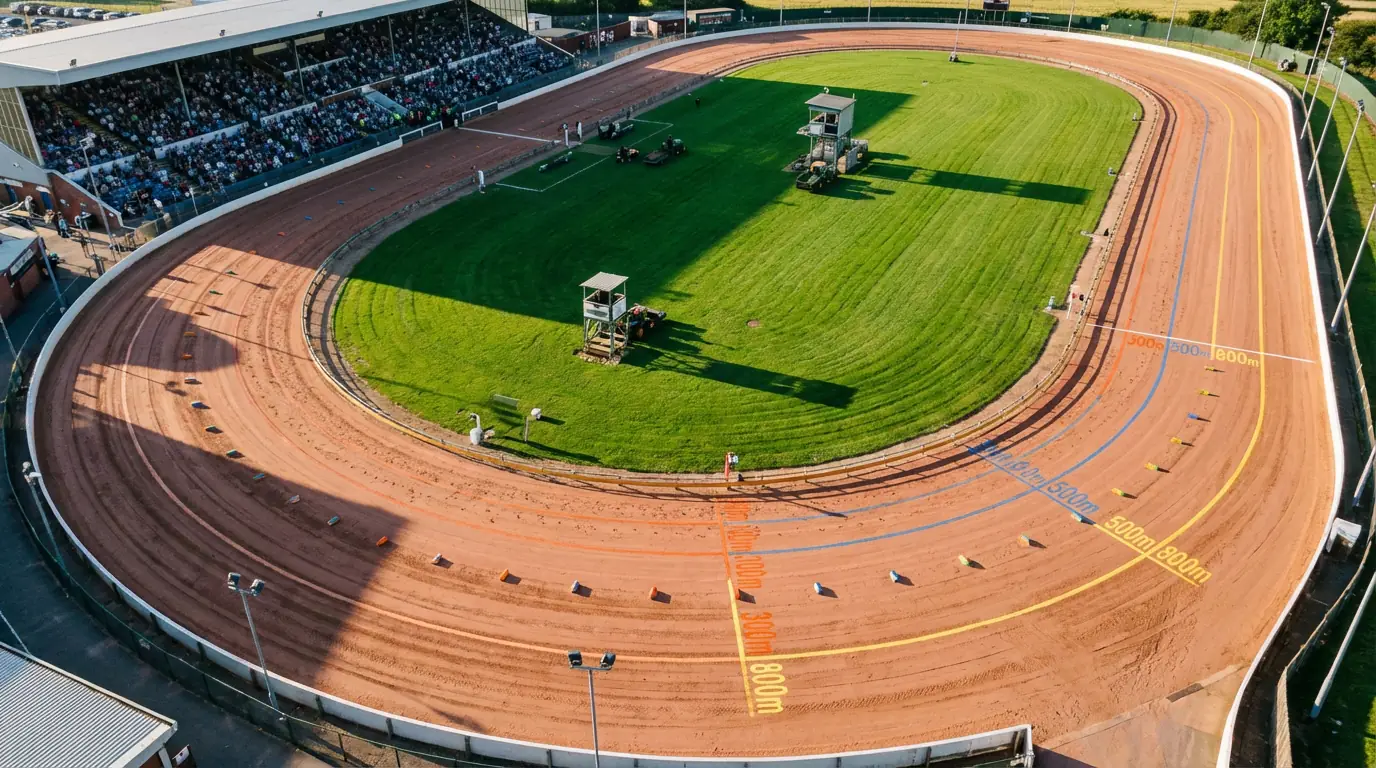
Sprint distances at UK tracks vary depending on the circuit layout, but the most common sprint trips fall between 210 and 285 metres. At tracks like Romford, the sprint distance is around 225 metres — just one bend. At larger circuits, sprint distances might be closer to 285 metres and include two bends. The number of bends matters enormously in sprints, because each bend is an opportunity for interference and an advantage for inside runners.
The betting dynamics in sprints are distinctive. Trap draw carries more weight than in any other distance category, because the dog with the shortest path to the first bend has less ground to cover and less chance of being impeded. In one-bend sprints, inside traps dominate the win statistics at virtually every track. Backing trap six in a sprint at a tight track is a losing proposition over any meaningful sample.
Early pace is the single most important form indicator for sprint races. Dogs with consistently fast first-section times — regardless of their finishing positions over standard distances — are the ones to watch in sprints. A dog that leads to the first bend in a 480-metre race and then gets caught in the final straight might be a sprint specialist being asked to go too far. Move it to 260 metres and the distance problem disappears.
Sprint races also produce more predictable results overall. With less time for things to go wrong, the best-drawn, fastest-breaking dog tends to win more often than in standard-distance races. Odds on sprint favourites are consequently shorter, and the each-way market offers less value because fewer outsiders sneak into the places. If you bet sprints, singles on the likely leader are usually sharper than place-based bets.
Standard Distances: 450m to 500m
The standard trip is where most greyhound racing happens. Distances between 450 and 500 metres — roughly equivalent to one full lap of the track, with four bends — account for the majority of races at every UK stadium. This is the distance that the grading system is primarily calibrated around, and it’s where the deepest form data exists.
Standard-distance racing tests a balance of attributes: early pace to avoid first-bend trouble, stamina to maintain speed through four bends and two straights, and racing intelligence to navigate traffic and find a clear run. The best standard-distance dogs combine all three. Dogs that excel in one area but lack in another — blazing speed but no stamina, or strong finishing pace but no early speed — tend to be inconsistent over this trip.
From a betting perspective, standard-distance races are the most analysable. The form database is largest here, the grading system is most accurate, and the variables — trap draw, running style, recent form, grade changes — are most reliably informative. If you’re building a systematic approach to greyhound betting, standard distances are the foundation. The sheer volume of races means you’ll never lack opportunities, and the analytical tools work best over this trip.
The tactical element is also most pronounced at standard distances. Unlike sprints, where the fastest breaker usually wins outright, standard races produce genuine midfield battles, late surges, and reversals of fortune. Dogs that are slow away but finish strongly can win standard-distance races that they’d lose at sprint distances. This creates opportunities for each-way betting, forecast combinations, and value identification that don’t exist as reliably in shorter races.
Middle and Staying Distances: 630m to 900m+
Staying races test attributes that most greyhound racing ignores. While the standard trip rewards speed and agility, distances above 600 metres reward stamina, racing rhythm, and the ability to sustain effort through six, eight, or even ten bends depending on the track and distance. The character of the racing changes dramatically. Front-runners that dominate over 480 metres often fade badly when asked to go 680 or further.
Middle distances — 630 to 700 metres — represent the transition zone between standard and staying trips. Dogs that have the speed for the standard trip plus a bit of extra stamina can handle these distances well. The fields in middle-distance races often include dogs that are genuinely suited to the trip and dogs that are trying it for the first time after showing stamina over the standard distance. Identifying which category each runner falls into is a significant betting edge.
True staying races — 800 metres and above — are a specialist discipline. Towcester, with its large circuit, hosts the longest races in UK greyhound racing, with staying trips exceeding 900 metres. These races require dogs that can settle into a rhythm rather than sprint, conserve energy through the early bends, and still have the acceleration to finish the race strongly. The greyhound equivalent of a long-distance runner rather than a sprinter.
Betting on staying races demands a different analytical emphasis. Early pace matters less — a slow break over 900 metres costs relatively little because there’s so much race left to run. Stamina indicators matter more: has the dog raced over similar distances before? Did it finish its previous staying race strongly or fade? What does the pedigree suggest about stamina? (Certain sire lines are known for producing stayers.) Trap draw still matters, but its influence is diluted over the greater number of bends.
Staying races also produce higher tricast dividends on average. The longer the race, the more time there is for the field to spread out and for unexpected results to emerge. Dogs that would never threaten over 480 metres sometimes find their way into the frame over 700 metres because stamina is a different currency. If you enjoy forecast and tricast betting, staying races are worth exploring specifically because the results are less predictable than at shorter trips.
How Distance Affects Dog Selection and Betting
The first question to ask when looking at any racecard is whether each dog in the field is suited to the distance. This sounds obvious, but a surprising number of punters skip it. They look at the form figures, see a string of wins, and back the dog without checking whether those wins came over the same distance as today’s race.
A dog with a form line of “1112” earned over 480 metres is a proven winner at the standard trip. If today’s race is over 680 metres, those form figures are less relevant. The dog may have the stamina to handle the extra distance, or it may not — and you can’t know from standard-distance form alone. Look for any previous runs at middle or staying distances, check whether the dog finished its standard races strongly (suggesting stamina) or faded (suggesting it’s already at its distance limit), and factor that into your assessment.
Conversely, a dog with moderate standard-distance form that has shown strong staying form might be underpriced in a middle-distance race. The market often prices dogs based on their most recent results without adequately adjusting for distance suitability. A dog that finished fourth over 480 metres but won impressively over 660 metres in its previous run might drift to generous odds for a middle-distance race because casual bettors focus on the more recent fourth-place finish.
Distance changes also interact with trap draw. In sprints, the inside trap advantage is magnified. Over staying trips, it’s reduced. If a dog is moving from a sprint distance to a staying distance, its previous trap bias data becomes less relevant. Assess the dog for the distance it’s running today, not the distance it ran last week.
Finally, keep a mental note of which dogs in your regular racecard rotation are distance specialists. Every track has a few dogs that run significantly better over one trip than another. When they turn up at their favoured distance, they often represent value — not because the market doesn’t know about the preference, but because the market is slow to adjust when a dog switches between distances on the same racecard.