Best Greyhound Betting Sites – Bet on Greyhounds in 2026
Loading...
Two Tiers, Two Different Betting Games
Not all greyhound races are created equal, and the most important dividing line in the sport isn’t between tracks or distances — it’s between open and graded racing. These two classifications determine the quality of the field, the way dogs are selected to compete, and the dynamics of the betting market. If you treat them the same way, you’re applying the wrong framework to at least half the races you bet on.
Graded racing is the daily bread of UK greyhound fixtures. Open racing is the main event. Understanding how they differ — and why those differences matter for your approach — is essential context that many punters skip entirely.
What Is Graded Racing?
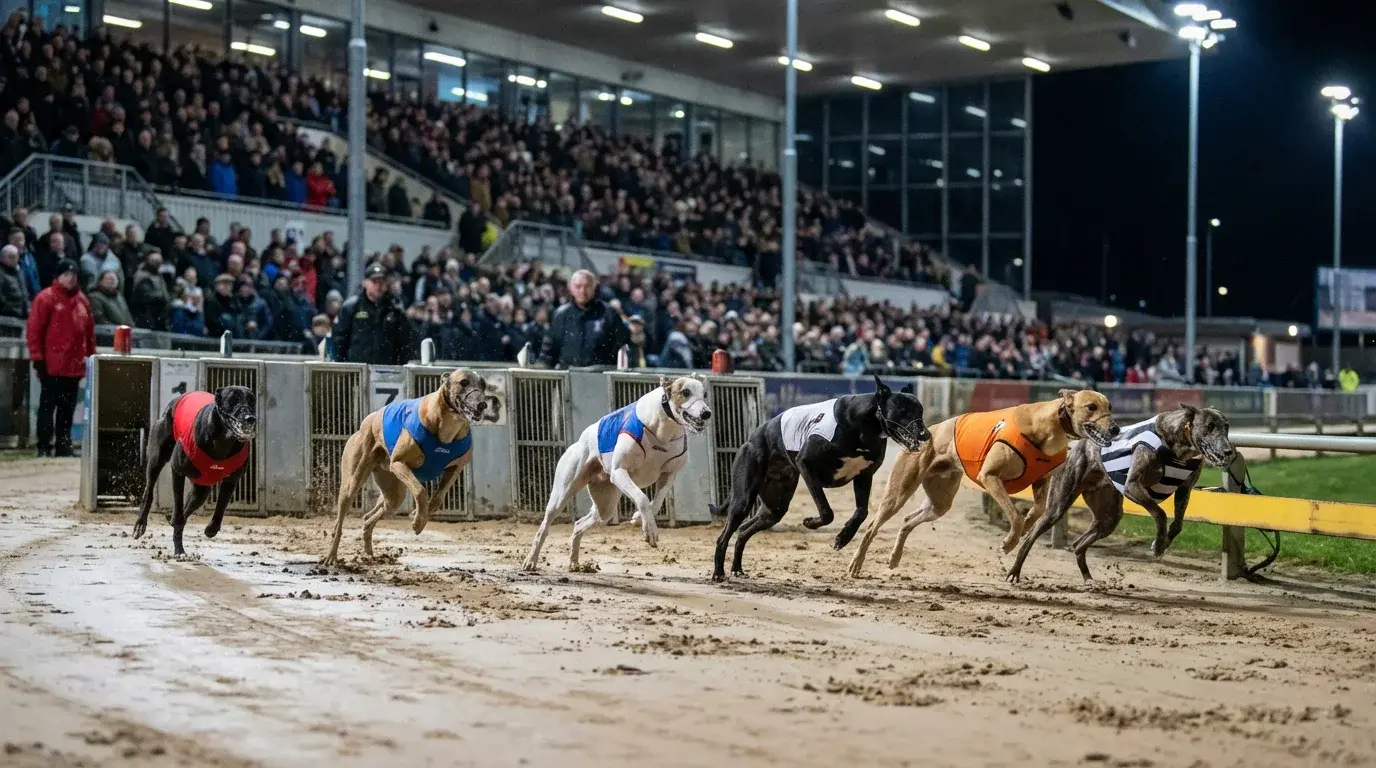
Graded racing is the classification system that underpins the vast majority of greyhound fixtures in the UK. Dogs are assigned a grade — A1 through to A10 or A11, depending on the track — based on their recent race times and finishing positions. Races are then assembled by grouping dogs of the same grade together, creating fields where every runner is theoretically of similar ability.
The grading system is managed by the racing manager at each individual track. After every race, results are reviewed and dogs may be promoted (raised a grade) or demoted (dropped a grade) depending on their performance. A dog that wins is almost always promoted by at least one grade. A dog that finishes well beaten may be dropped. This creates a continuous cycle where dogs rise through the grades as they improve and fall back when they meet stiffer competition.
Graded races form the backbone of BAGS meetings and regular Premier fixtures alike. The weekly schedule at any UK track is dominated by graded racing, with 10 to 14 graded races per meeting being typical. These races don’t carry individual names or special status — they’re the bread-and-butter competition that keeps the fixture list running and the betting markets supplied with content.
From a betting perspective, graded races are relatively predictable in structure. You know the approximate standard of the field before you even look at the racecard, because the grade tells you the ability band. Form analysis within a grade is straightforward: you’re comparing dogs that have been racing against similar opposition, at similar times, often at the same track. The data is directly comparable, which makes graded racing the most analytically accessible form of greyhound betting.
The limitation is that graded racing can produce repetitive fields. The same dogs may meet each other week after week if they remain in the same grade at the same track. When that happens, the market learns their relative ability quickly, and the odds become efficient. Finding value in a graded race where the same six dogs have already raced against each other three times in the past month is harder than finding value in a fresher contest.
What Is Open Racing?
Open racing sits above the grading system entirely. In an open race, there are no grade restrictions — any dog can be entered, regardless of its grade or track record. In practice, open races attract the best dogs available, because trainers target them for their highest-quality runners. The prize money is significantly higher than in graded races, and the prestige of winning an open event carries weight in the sport.
Open races are typically the headline events at Premier meetings. They may be standalone races on a card otherwise filled with graded racing, or they may form part of a competition — heats, semi-finals, and finals staged over several weeks. Category One and Category Two competitions, including the English Greyhound Derby, the St Leger, and regional derbies, are all run as open races.
The field composition in open racing is fundamentally different from graded racing. Instead of six dogs drawn from the same grade at one track, an open race might feature dogs from different tracks, different grades, and different training backgrounds. A kennel in Sussex might send a dog to compete in an open race in Yorkshire if the race conditions suit. This geographic mixing produces fields that are harder to assess because the dogs haven’t necessarily raced against each other before, and their form was earned against different levels of opposition.
The quality ceiling in open racing is higher. The fastest dogs in the country compete in open events, and the times posted in top-level open races are significantly quicker than anything you’d see in graded racing. For bettors, this means the margin between dogs is often narrower — the difference between first and sixth in an open race might be a length, whereas in a low-grade graded race, the winner might be five or six lengths clear.
How Classification Affects Betting Markets
The distinction between open and graded racing creates two different betting environments, each with its own characteristics and opportunities.
Graded racing markets tend to be less liquid but more predictable. Fewer people analyse low-grade BAGS races in detail, which means the odds are set primarily by the bookmaker’s tissue price and adjusted by relatively small volumes of money. This can create value for punters who do their homework, because the opening prices are sometimes less accurate than in higher-profile markets. The flip side is that the maximum stakes bookmakers will accept on graded races are lower, and the odds can shift sharply on modest bets.
Open racing markets are more liquid and attract more attention from serious bettors, form analysts, and tipsters. The odds are generally more accurate because more information is publicly available and more money flows through the market. Finding value is harder — but when you do find it, the stakes accepted are higher and the market is less likely to move against you before the off.
Forecast and tricast markets behave differently too. In graded racing, where the ability gap between runners is small by design, the first three finishers can come from almost anywhere in the field. Tricast dividends in competitive graded races are often substantial. In open racing, the elite dogs tend to finish near the front more reliably, which compresses the forecast market but can still produce good-value tricast combinations when the third-place finisher is an outsider.
Another market difference is the availability of ante post betting. Open competitions — especially major events like the Derby or the St Leger — have ante post markets that open weeks before the event. Graded races don’t. If you enjoy ante post betting, open racing is where that opportunity lives. The early prices in ante post markets can be significantly different from the on-the-day odds, creating value for punters who follow the sport closely enough to identify likely contenders before the wider market catches up.
The each-way market also shifts between the two formats. In open racing, where the quality is high and the margins are thin, each-way bets at medium odds offer better value because more dogs have a realistic chance of placing. In one-sided graded races — where one dog is clearly better than the rest — each-way value is concentrated on finding the right runner for the place money behind the likely winner.
Choosing Between Open and Graded Meetings
Both formats offer betting opportunities, but they reward different approaches. Graded racing rewards consistency, track knowledge, and form analysis depth. If you follow one or two tracks closely, build up knowledge of the regular runners, and analyse the grades and running comments diligently, graded racing is where your accumulated knowledge converts into value most efficiently.
Open racing rewards broader sport knowledge and the ability to assess unfamiliar dogs from different tracks. It’s a harder analytical challenge because the data is less directly comparable, but the prize for getting it right is often a more liquid market with better returns. If you follow the sport nationally — tracking the top dogs, the major kennel operations, and the competition pathways — open racing is where that breadth of knowledge pays off.
Most profitable greyhound punters don’t choose one or the other exclusively. They bet graded racing as their steady baseline and treat open racing as an overlay — a higher-stakes opportunity that comes along less frequently but offers different value when it does. The worst approach is to treat both formats identically, applying the same analytical shortcuts to an open Derby heat that you’d use for a Tuesday afternoon A6 race at Romford. The data is different, the fields are different, and your strategy should be different too.