Best Greyhound Betting Sites – Bet on Greyhounds in 2026
Loading...
When the Field Changes After You’ve Bet
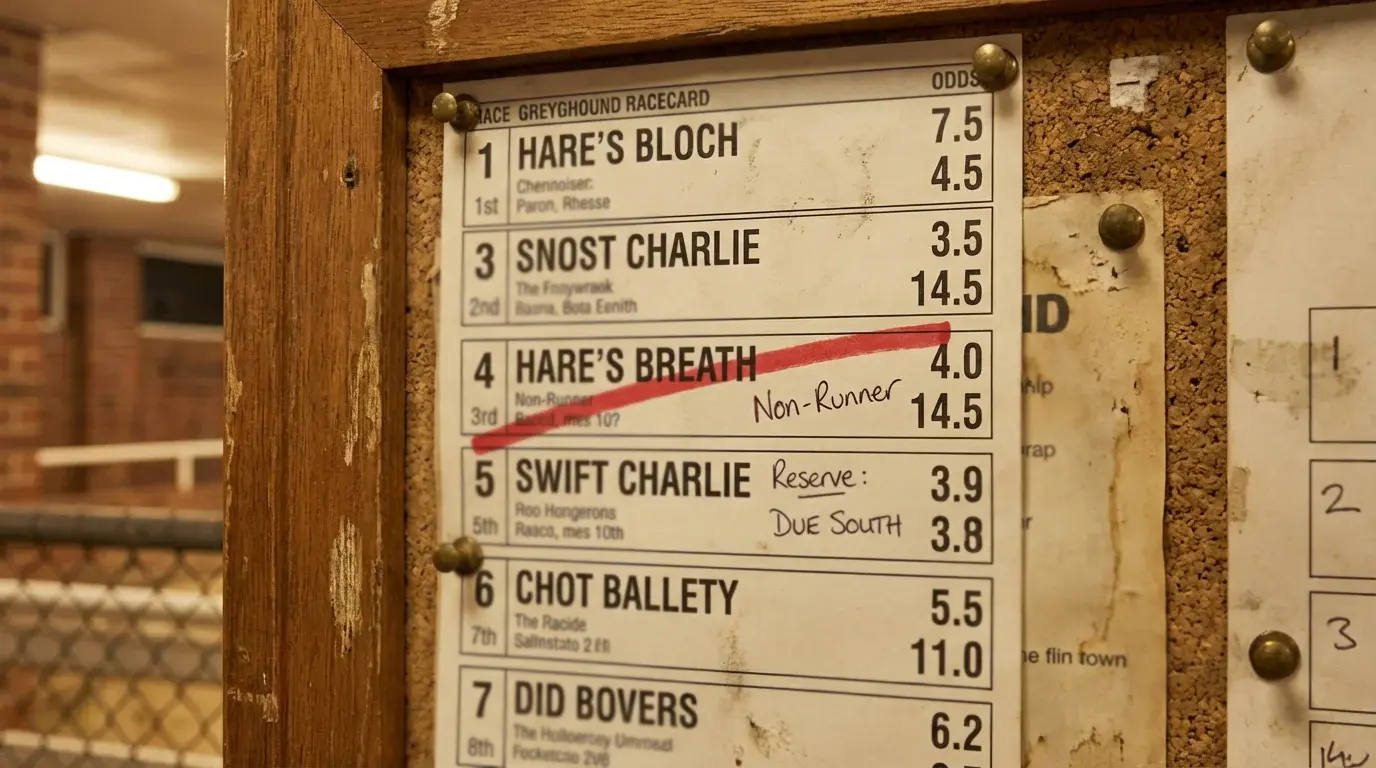
You’ve studied the form, assessed the traps, identified your selection, and placed your bet. Then the racecard updates: one of the six runners is withdrawn, and a reserve enters the field. The race you analysed no longer exists. A different dog is running from a different trap, the dynamics of the first bend have shifted, and the odds have been recalculated. This scenario isn’t unusual in greyhound racing — it’s routine. Non-runners happen at virtually every meeting, and how they affect your bet depends on the specifics of the withdrawal and the rules your bookmaker applies.
Dealing with non-runners is part of the practical machinery of greyhound betting. It’s not glamorous, but misunderstanding the rules can cost you money. Knowing what triggers a withdrawal, how reserves work, and what happens to your stake when the field changes is essential housekeeping.
What Causes a Non-Runner?
Greyhounds are withdrawn from races for a variety of reasons, most of which relate to the dog’s health or fitness on the day of the meeting. The most common cause is a minor injury or ailment detected during the pre-race veterinary inspection. Every dog entered in a race is examined by a track veterinarian before the meeting. If the vet identifies any issue — a muscle strain, a cut, signs of illness, lameness — the dog is withdrawn. Trainer safety and welfare standards under GBGB rules leave no room for compromise here.
Season is another common cause. Female greyhounds in season are automatically withdrawn from competition. This is a biological event that can’t be predicted with precision, and it occasionally removes strong contenders from important races at short notice. When a bitch is withdrawn due to season, it can be particularly disruptive to ante post markets for competitions where heat draws have already been published.
Trainers can also withdraw a dog for operational reasons — though this is less common and requires notification to the racing office within specific time frames. A trainer might withdraw a dog if the going conditions are unsuitable, if the dog hasn’t trialled satisfactorily, or if they decide to redirect it to a different meeting that better suits its preparation schedule. These tactical withdrawals are rarer than health-related scratching but do occur, particularly at the higher levels of the sport.
Late non-runners — dogs withdrawn after the final declarations but before the race — create the most disruption. At this point, the racecard is already published, odds have been posted, and many punters have already placed their bets. The later the withdrawal, the less time the market has to adjust, which is why late non-runners often trigger the most significant odds movements and the most confusion about settlement rules.
How Reserves Enter the Field
Every greyhound meeting includes reserve dogs — runners that are on standby to replace any non-runner before the race. Typically, two reserves are declared for each race, numbered as reserve one and reserve two. If a dog is withdrawn, reserve one takes its place. If two dogs are withdrawn, both reserves enter.
The reserve inherits the trap number of the withdrawn dog. If trap three is vacated by a non-runner, the reserve runs from trap three, wearing the white jacket assigned to that position. This matters for betting because the reserve dog may have a completely different running style to the dog it replaced. A railer replacing a wide runner in trap three creates a different race dynamic. The form you analysed for the original runner is irrelevant — you now need to assess the reserve’s form in that trap position.
Reserve dogs are listed on the racecard, typically at the bottom of the field information. Their form is publicly available, so you can assess them in advance. Many experienced punters make a habit of checking the reserves before the meeting starts, forming a quick opinion on how the race might change if a reserve enters. This preparation takes a few minutes and can prevent you from being caught out by a late substitution.
The timing of the substitution affects whether your bookmaker allows you to withdraw your bet. If a non-runner is declared before the market opens, the reserve simply appears on the card and bets are placed on the revised field. If the non-runner is declared after bets have been placed, different rules apply depending on the bookmaker and the specific circumstances. Some operators void bets on the non-runner and allow you to re-bet on the revised field. Others apply Rule 4 deductions — a proportional reduction in your payout to reflect the change in the field.
Rule 4 Deductions Explained
Rule 4 is the mechanism that adjusts payouts when a runner is withdrawn after the market has formed. It’s named after Rule 4 of the Rules of Racing, and it applies whenever a dog is withdrawn close enough to the off that the bookmaker wasn’t able to reform the market properly. The deduction is applied to winning bets and is based on the odds of the withdrawn dog at the time of withdrawal.
The logic is straightforward. If a 2/1 chance is withdrawn from a six-dog race, the remaining five dogs all have a better chance of winning. The odds should shorten across the board to reflect this. But if you’ve already locked in your price, your odds don’t change — so Rule 4 applies a percentage deduction to your winnings to account for the improved probability.
The deduction scale is standardised. If the withdrawn dog was priced between 1/9 and 2/11, the deduction is 90p in the pound. At 6/4, it drops to around 20p. At 5/1 or longer, the deduction is around 10p. The shorter the price of the withdrawn dog, the larger the deduction, because the removal of a strong contender improves the chances of every remaining runner more significantly than the removal of a long shot.
In practice, Rule 4 deductions in greyhound racing are most commonly triggered by late non-runners — dogs withdrawn within an hour of the race. If a non-runner is declared in the morning for an afternoon race, the bookmaker typically has time to reform the market entirely, and Rule 4 doesn’t apply. The closer to the off the withdrawal occurs, the more likely a deduction will be applied.
Rule 4 deductions apply to the profit portion of your bet, not the stake. If you bet £10 at 4/1 and a 15p Rule 4 deduction applies, your profit is reduced from £40 to £34. You still receive your £10 stake back. The deduction is irritating but usually modest for bets on non-favourites. Where it stings is when the withdrawn dog was a strong favourite, triggering a large deduction that significantly reduces your payout even though your selection won.
One scenario that catches punters off guard: Rule 4 deductions applied to accumulators. If one leg of your acca is affected by a non-runner Rule 4, the deduction is applied to that leg before the returns roll onto the next selection. This reduces the compounding effect and can substantially lower the final payout of a multi-leg bet. Always check whether any legs of your accumulator have been affected by non-runners before assuming you know your return.
How Non-Runners Affect Your Bet
The impact of a non-runner on your bet depends on the relationship between the withdrawn dog and your selection. If the non-runner was the dog you bet on, your bet is voided and your stake returned — no deduction, no loss, just a flat return. If the non-runner was a rival to your selection, the race has become easier for your dog, but you’ll face a Rule 4 deduction if you win.
There’s a subtler effect too. When a non-runner is replaced by a reserve, the trap dynamics change. If your selection’s edge was partly based on a favourable first-bend scenario — for instance, a railer in trap one with a slow breaker alongside in trap two — and the non-runner was that slow breaker, the reserve in trap two might be an entirely different proposition. A fast breaker replacing a slow one changes the race shape at the first bend, which can undermine or enhance your selection’s chances depending on the circumstances.
For forecast and tricast bets, non-runners are particularly disruptive. Your forecast was built on a specific combination of two or three dogs. If one of them is withdrawn, the bet is voided. If a different dog is withdrawn and a reserve enters, your forecast combination is still live but the race dynamics have changed. A forecast that looked strong with the original field might be less compelling with a reserve in the mix.
The best defence against non-runner disruption is awareness. Check for non-runners before the race, not after your bet has settled. Most bookmaker apps update racecards in real time, flagging withdrawals and reserves as they’re declared. If a non-runner changes the race significantly — removing a key rival, introducing an unknown reserve, or triggering a large Rule 4 deduction — you may want to adjust your staking or switch to a different race entirely. Flexibility in the face of late changes is a practical skill that protects your bankroll more effectively than any form analysis can.