Best Greyhound Betting Sites – Bet on Greyhounds in 2026
Loading...
Grades Are the League Table of Greyhound Racing
Every racing greyhound in the UK sits in a grade — and that grade dictates who they run against. It’s the sport’s equivalent of a division system, designed to ensure that dogs of similar ability compete against each other rather than being thrown into fields where one runner has a massive advantage over the rest. If you’ve ever wondered why a dog that won three races in a row suddenly finishes last, the answer is almost always grading. It stepped up in class and met better opposition.
For bettors, the grading system is fundamental. It determines the competitiveness of a field, the reliability of recent form, and the likelihood of a race producing a predictable outcome. A dog that dominates at A6 level may be entirely ordinary at A4. Knowing the grades — and, more importantly, knowing when a dog is moving between them — is one of the most practical edges available to anyone who takes greyhound betting seriously.
The system is simple in principle but layered in application. Grasping the basics takes five minutes. Understanding how grade changes affect betting markets takes considerably longer.
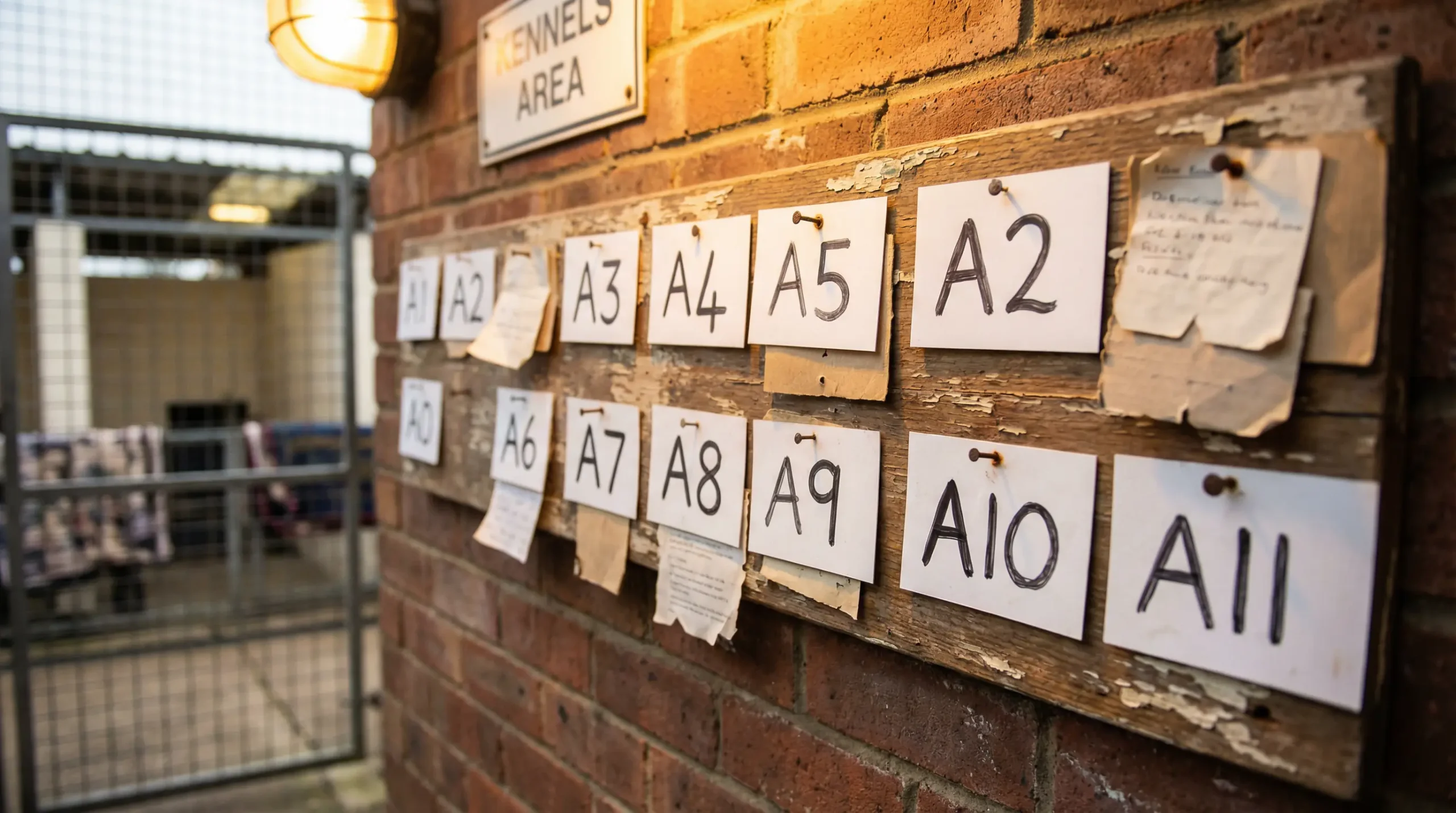
The Grading Structure: A1 Through to A11
The GBGB grading system runs from A1 at the top down to A11 at the bottom, though not every track uses the full range. Most stadiums operate with grades from A1 to A9 or A10, depending on the volume and quality of dogs available at that venue. The ‘A’ prefix stands for a standard distance race — typically around 480 metres, give or take, depending on the track. Sprint races carry an ‘S’ prefix, while staying events use ‘D’ or a similar marker, each with their own parallel grading ladder.
At A1, you’ll find the best graded runners at a given track — dogs posting the fastest times, winning consistently, and competing at a level just below open-race standard. These are the animals that might eventually progress to Category Two or Category One competitions. At A11, you’ll find dogs that are either very young and still learning, returning from long breaks, or simply not fast enough to compete higher up. The gap in quality between A1 and A11 is substantial. An A1 dog at Nottingham would typically cover 480 metres several lengths faster than an A11 runner at the same track.
Each grade is intended to group dogs of broadly similar ability based on their recent race times. The grading system uses a combination of finishing times, finishing positions, and the grades of races previously contested to place a dog in the appropriate band. This isn’t an exact science — there’s discretion involved, and racing managers at individual tracks play a role in assessing where a dog fits. But the framework is consistent enough to create competitive fields at every level.
It’s worth noting that grades are track-specific. An A3 dog at Romford is not necessarily the same standard as an A3 dog at Towcester. Track distances, bend configurations, and surface conditions all affect times, so a dog’s grade at one track doesn’t automatically transfer to another. When a dog moves between tracks — which happens regularly — it may be re-graded based on a trial run or its initial race performance at the new venue.
Below the A-grade ladder, some tracks also run lower-tier categories sometimes labelled as ‘B’ grades or novice races. These cater to dogs that are new to racing, returning after long absences, or simply too slow for even the lowest A grades. Novice races can be unpredictable and are generally less useful for systematic form analysis, though they occasionally produce future open-class runners whose early odds reflect their lack of public form rather than their actual ability.
How Dogs Move Between Grades
Win too often and you go up. Lose too often and you drop. That’s the core principle, though the mechanics are slightly more nuanced than that summary suggests.
After each race, the racing manager at the track reviews the results and decides whether any runners should be re-graded. A dog that wins is almost always raised by one grade — sometimes two if the winning time was significantly faster than expected for the grade. A dog that finishes last or posts a notably slow time may be dropped by one grade. Dogs that finish in the middle of the field without doing anything remarkable typically stay where they are.
The system creates a natural cycle. A dog enters at a grade that matches its trial time, wins a couple of races as the best runner at that level, gets promoted, and then faces stiffer competition. If it continues to win, it keeps climbing. If it can’t cope with the higher grade, it loses, gets demoted, and returns to a level where it’s competitive again. Most racing greyhounds spend their careers bouncing between two or three adjacent grades, finding a band where they’re competitive without being dominant.
Timing matters too. A dog that hasn’t raced for several weeks may be re-graded based on a trial rather than its last competitive result. Trainers sometimes request specific trial distances or times to influence grading decisions, particularly when moving a dog to a new track or bringing one back from injury. The trial system gives racing managers data, but it also gives trainers a degree of tactical control over where their dogs are graded.
Promotion and demotion are not always one-step movements. A dog that wins its A6 race in a time that would be competitive at A3 level might jump two grades at once. Similarly, a dog that was clearly outclassed in an A4 race might drop straight to A6 rather than going through A5. These multi-grade moves tend to happen more often at the extremes — either when a dog shows dramatically improved form or when it’s clearly struggling.
Why Grading Matters for Betting
A dog dropping in grade isn’t always declining — sometimes it’s being given an easier opportunity. This is one of the most commonly misunderstood aspects of greyhound betting, and it’s where the grading system directly translates into profit potential.
Consider a dog that’s been racing at A3 and finishing third or fourth consistently. It hasn’t been disgraced, but it hasn’t been winning either. The racing manager drops it to A4. Now it’s the best dog in a weaker field. If you spotted the grade change on the racecard and recognised the dog’s A3 form was strong enough to dominate at A4, you had an edge over punters who only looked at the recent finishing positions and saw a string of thirds and fourths.
The opposite scenario is equally important. A dog that’s just been promoted from A6 to A5 after two wins is an unknown quantity at the higher level. Maybe it’s genuinely improved and will continue winning. Maybe it was just the best runner in a weak A6 field and will be exposed against better opposition. The odds often don’t adequately distinguish between these two possibilities, which creates both risk and opportunity.
Grade changes also affect forecast and tricast markets. In a race where one dog has dropped in grade and is likely to be competitive, the key question shifts from “will it win?” to “who finishes second?” Identifying the likely winner through a grade analysis frees you to focus your forecast combinations on the battle for second and third place, which is often where the real value lies in six-dog fields.
There’s a practical habit worth developing: whenever you look at a racecard, check whether any runner has changed grade since its last race. Most racecard services display a dog’s current grade and its recent race history, making grade changes easy to spot. It takes about 30 seconds per race and gives you a piece of information that many casual punters overlook entirely.
When Class Tells: Reading Grade Changes on the Card
Grade changes on the racecard are one of the most actionable signals available, but only if you read them correctly. A drop in grade after a poor performance might indicate a dog that’s lost form and will continue to struggle. A drop after a run where the dog was hampered, bumped, or trapped wide might indicate a dog that was simply unlucky and is now meeting easier opposition with the same ability it always had.
The form comment is your friend here. Running remarks like “bumped first bend,” “checked second,” or “slow away” all suggest that a poor finishing position might not reflect the dog’s true ability. If you see those comments alongside a subsequent grade drop, you’re potentially looking at a dog that’s better than its new grade suggests — a classic value bet.
Equally, be wary of dogs that have been promoted after winning in unusually slow times. A win is a win, and the grading system rewards it. But if the winning time was only fractionally faster than the grade average, the dog might not have the raw speed to compete at the next level. These are the runners that get promoted, run once at the higher grade, and immediately get dropped back down.
The grading system isn’t perfect, and it isn’t meant to be a prediction tool. It’s a classification tool that produces competitive races. As a bettor, your job is to find the spots where the classification doesn’t quite match reality — where a dog is slightly better or slightly worse than its grade implies. Those gaps are where the value sits, and the grading system, for all its simplicity, produces them with reliable frequency.