Best Greyhound Betting Sites – Bet on Greyhounds in 2026
Loading...
The Argument That Never Ends
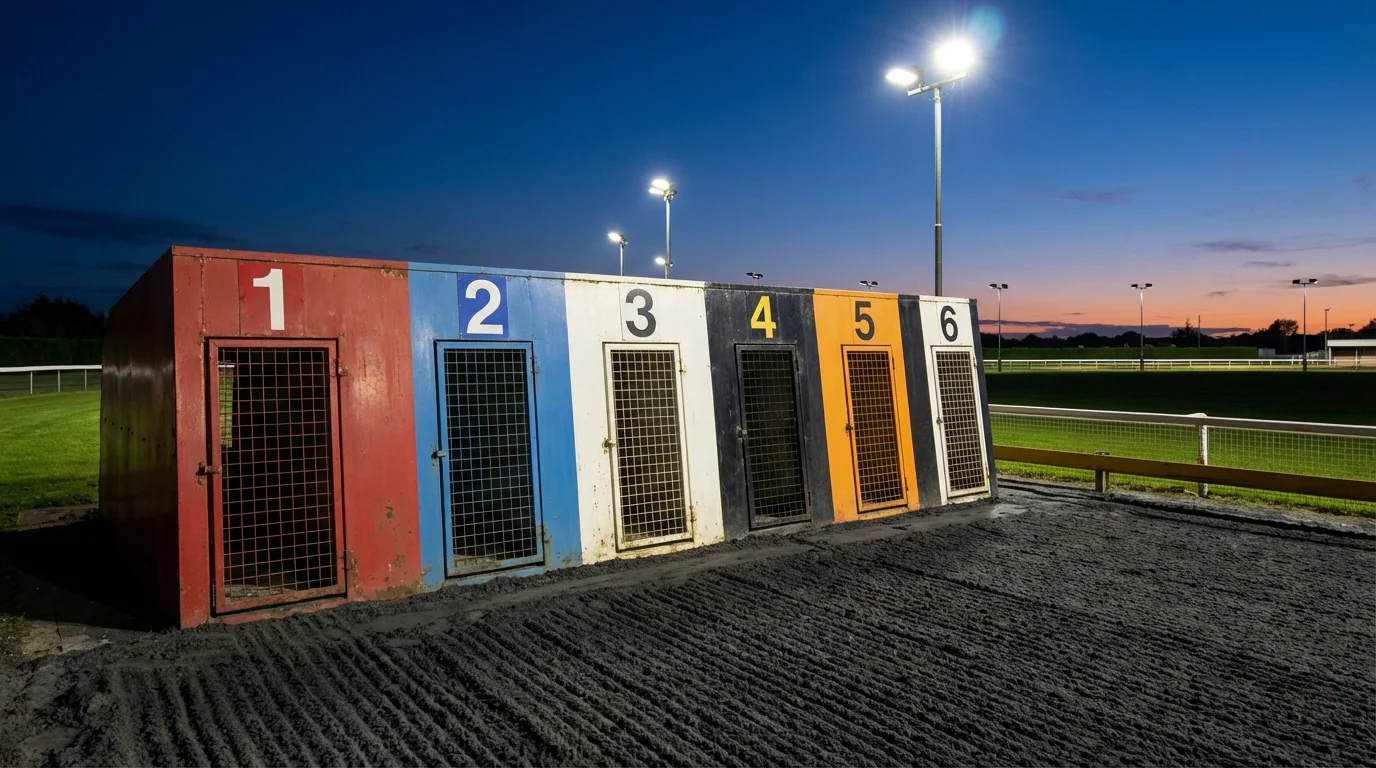
Ask any greyhound punter whether the trap matters and you’ll get a different answer every time. Some swear by inside draws, backing trap one and two almost on principle. Others dismiss trap bias entirely and focus only on the dog’s individual form. The truth, predictably, sits somewhere between the two — but it’s closer to the data-driven camp than most casual punters realise.
Trap draw is not the single most important factor in a greyhound race. The dog’s recent form, its fitness, the grade of the race, and the quality of opposition all matter more in isolation. But the trap is the one variable that’s fixed before the race starts and interacts with everything else. A front-running railer drawn in trap six faces a fundamentally different challenge than the same dog drawn in trap one. The question isn’t whether the trap matters. It’s how much, and at which tracks.
If you’re dismissing trap data entirely, you’re leaving information on the table. If you’re obsessing over it at the expense of form analysis, you’re building your strategy on the wrong foundation. The sensible position is somewhere in between: use trap data as a filter, not a verdict.
Trap Bias Data Across UK Tracks
When you pool results across thousands of races, patterns emerge. At most UK greyhound tracks, trap one wins more often than any other trap over large sample sizes. This isn’t a dramatic advantage — typically around 18-20% of wins from trap one versus 14-16% from the least successful trap — but it’s consistent enough to be statistically meaningful rather than random noise.
The reason is structural. Trap one is closest to the inside rail. A dog that breaks cleanly from trap one has the shortest path to the first bend and can establish the rail position without having to cross in front of other runners. Since greyhound tracks are oval, the rail position is advantageous throughout the race — it covers less distance than the wider paths. A dog on the rail saves ground at every bend, which compounds over a four-bend race into a measurable time advantage.
Trap six, the widest, has the opposite problem. The dog needs to either cut across the field to reach the rail — risking interference and bumping — or stay wide and cover extra ground. At tracks with tight bends, this disadvantage is more pronounced. At tracks with wider, more sweeping bends, the outside traps suffer less because there’s more room to run and the distance penalty is smaller.
The middle traps — three and four — tend to produce results that cluster around the average. These dogs have options: they can rail if there’s space inside, or they can stay mid-track and let the race unfold. The flexibility of the middle traps means they’re less influenced by track geometry and more dependent on the individual dog’s running style and break speed.
Sample sizes matter enormously when interpreting trap data. A trap bias calculated from 50 races at one track might be entirely random. A bias calculated from 5,000 races at the same track is a genuine feature of the venue’s geometry. Most reputable form services — Timeform, Racing Post, GBGB’s own data — publish trap statistics with sufficiently large samples to be useful. If you’re using trap data from a small or unverified sample, you’re not really using data at all. You’re using anecdote.
One critical nuance: trap bias is distance-dependent. The same track can show different trap advantages over different distances. At a track where sprint races start near a bend, the inside trap advantage can be enormous. Over the standard distance, where the start is on a straight, the advantage may be smaller. Always check trap statistics for the specific distance of the race you’re betting on, not just the track-level averages.
How Trap Draw Interacts with Running Style
The trap number means nothing without knowing how the dog runs. A railer — a dog that naturally gravitates to the inside rail — benefits enormously from trap one because it doesn’t need to cross any other runner’s path to reach its preferred position. The same railer drawn in trap five faces a problem: it has to navigate across four other dogs to get to the rail, which means it’s likely to lose ground at the first bend, potentially get bumped, and start the race from a disadvantaged position.
Wide runners — dogs that prefer to race on the outside of the pack — show the opposite pattern. A wide runner from trap six has clean air and room to stride out without interference. The same dog from trap one is stuck on the rail with nowhere to go, hemmed in by other runners, and unable to employ its natural running style.
Front-runners add another layer. A fast-breaking dog from any trap can overcome a positional disadvantage simply by getting to the first bend ahead of the field. If a dog has the early pace to lead into the first bend, the trap draw matters less because the dog dictates the race from the front. It’s the dogs that lack early pace — the ones that settle in mid-pack and try to finish strongly — where trap draw has the greatest influence, because those dogs are most vulnerable to interference and crowding through the bends.
This interaction between trap and style is why raw trap bias data can be misleading without context. If trap one wins 20% of races at a given track, that might partly reflect a genuine geometric advantage and partly reflect the fact that racing managers tend to draw the best early-pace dogs in trap one. Disentangling the two requires looking not just at trap statistics, but at the specific running styles of the dogs involved in each race.
Track-Specific Trap Advantages
Some tracks favour inside runners; others open up wide. The variation is significant enough to affect your betting approach at different venues.
Romford, with its tight bends and short circuit, amplifies the inside trap advantage. The rail position is worth more here than at almost any other UK track, and dogs drawn wide often struggle to get competitive at the first bend unless they have exceptional early speed. Betting on Romford without accounting for the trap draw is leaving money on the table.
Towcester, by contrast, has a larger circumference and wider bends. The inside advantage still exists, but it’s diluted. Dogs drawn in traps five and six have more room to operate, and the distance penalty for running wide is less severe. The result is more open racing, which makes Towcester’s races harder to predict from trap data alone but also produces more competitive fields and, frequently, better-value odds on outside runners.
Sheffield presents yet another profile. The track’s configuration gives a notable advantage to trap one over sprint distances, but the bias flattens considerably over standard trips. Dogs that break fast at Sheffield can dominate from any trap, while slower starters are more dependent on getting a favourable inside draw.
The practical lesson is that you can’t apply a generic trap theory across all tracks. Each venue has its own bias profile, and that profile can shift between distances. If you’re serious about using trap data, build a mental map of the two or three tracks you bet on most frequently, and know their specific trap tendencies. That targeted knowledge is worth far more than a vague sense that “trap one is usually good.”
Using Trap Data Without Overthinking It
Trap data adds a small edge — don’t try to build your entire strategy on it. The punters who get into trouble with trap analysis are the ones who start treating it as the primary factor, betting on trap positions regardless of the dog’s form, or avoiding certain traps superstitiously.
The sensible approach is to use the trap draw as a tiebreaker. When two dogs in a race look roughly equal on form, and one has a more favourable trap draw for its running style, the draw tips the balance. When a clearly superior dog is drawn in an unfavourable trap, the draw is a risk factor to account for — it might affect your staking level — but it shouldn’t override a genuine form advantage.
One useful exercise: after identifying your selection on form, check whether the trap draw supports or undermines the pick. If it supports, proceed. If it undermines, consider reducing your stake or looking for forecast value rather than backing the dog outright. If the draw is neutral, ignore it. This takes 15 seconds per race and keeps trap data in its proper place — as a tool, not a system.