

- Twenty Stadiums, Twenty Different Betting Puzzles
- How UK Greyhound Tracks Are Licensed and Regulated
- Major London and South East Tracks
- Midlands and Northern Tracks
- National-Level Venues: Towcester and Beyond
- Track Distances, Bends, and Surface Conditions
- Race Night Experience: What to Expect at Each Venue
- The Track Isn’t the Dog — But It Shapes the Race
Twenty Stadiums, Twenty Different Betting Puzzles
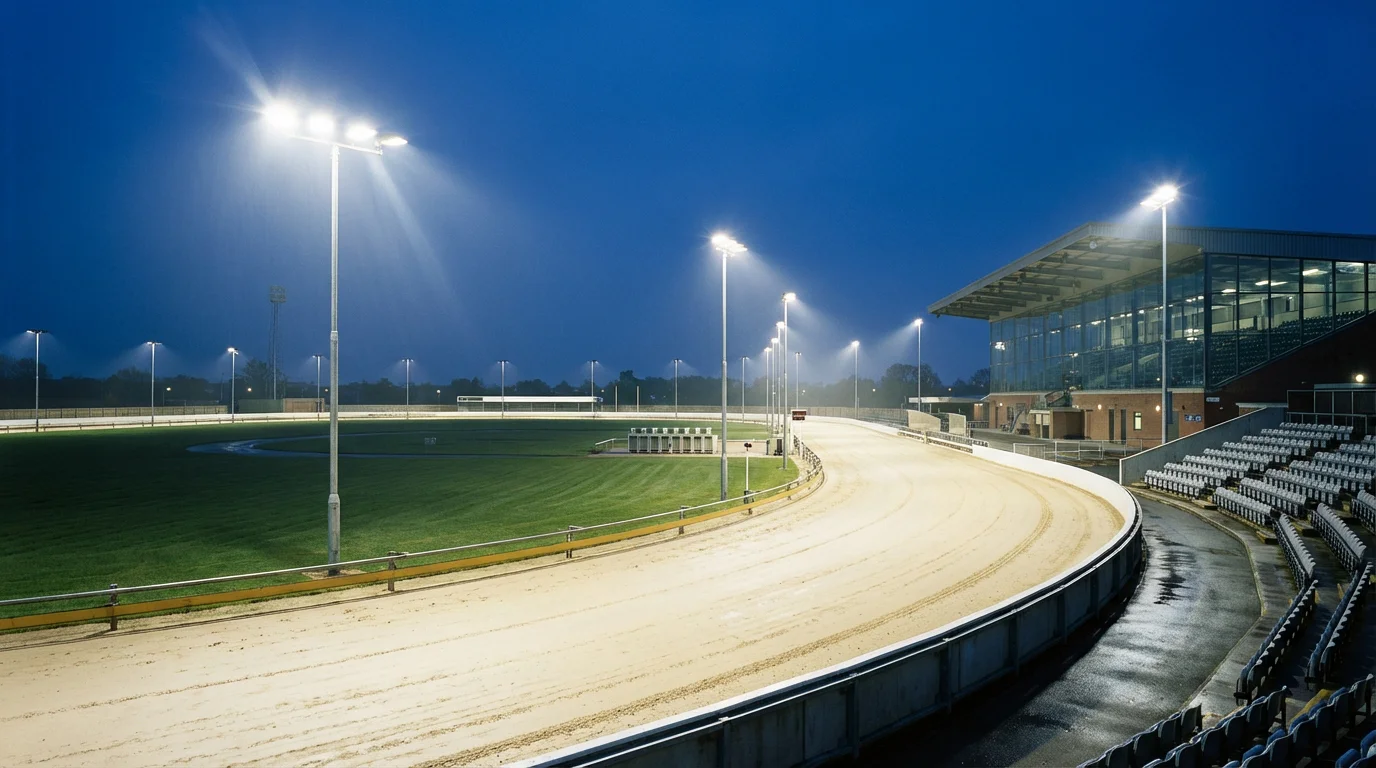
No two greyhound tracks in the UK run the same. That’s not a tourist board platitude — it’s a structural fact that affects every bet you place. Each venue has its own distances, its own bend geometry, its own trap biases, and its own pool of resident dogs that know every metre of the circuit. A greyhound that looks unbeatable at one track can look ordinary at another, and the difference is almost always the venue rather than the dog.
The UK currently operates eighteen licensed greyhound stadiums under the governance of the Greyhound Board of Great Britain. That number has shrunk considerably over the past few decades — there were over seventy licensed tracks in the 1940s — but what remains is a concentrated network of venues spread across England and Wales. Scotland’s last licensed track, Shawfield in Glasgow, closed in 2025, while Wales retains one licensed venue, though the Welsh Government has committed to implementing a ban on greyhound racing. The sport’s competitive geography is now almost entirely English.
For punters, this matters in two ways. First, understanding the physical characteristics of each track — its distances, bends, and surface tendencies — gives you an analytical edge over anyone who treats all greyhound racing as interchangeable. Second, knowing which tracks host the major competitions, which ones run the busiest BAGS schedules, and which ones produce the strongest open-race fields helps you target your betting where the opportunities are richest. This guide covers both: the individual venues and the broader patterns that connect them.
How UK Greyhound Tracks Are Licensed and Regulated
The Greyhound Board of Great Britain oversees every licensed track in the country. GBGB is the sport’s governing body, responsible for regulating racing, maintaining welfare standards, and licensing the stadiums where competitive greyhound racing takes place. Any track that wants to host races under rules — meaning races that bookmakers can offer markets on — must hold a GBGB licence and comply with the board’s regulations on everything from kennel facilities to track maintenance.
Licensing covers more than just the physical infrastructure. GBGB sets the grading system that determines which dogs compete against each other, regulates the drug-testing programme, and maintains the official results database. Trainers must be licensed too, and their kennels are subject to inspection. The regulatory framework is not decorative — it exists to ensure that when you look at a racecard, the data on it is produced under consistent, auditable conditions. A dog’s form figures at a GBGB-licensed track carry more reliability than results from an unlicensed flapping track, which operates outside the regulated system and has no standardised grading, testing, or reporting.
Flapping tracks still exist in parts of the UK, running informal meetings without GBGB oversight. They attract local interest and some betting activity, but the races are not covered by regulated bookmakers and the form data is not integrated into mainstream racecard platforms. For any punter using form analysis, data from flapping tracks is effectively unusable — it doesn’t feed into the grading system, and the conditions under which it was produced are unverifiable.
The distinction matters practically. When you bet on greyhound racing through a licensed bookmaker, you’re betting on GBGB-regulated meetings where the results are official, the starting prices are recorded, and the integrity measures are in place. That regulatory backbone is what makes systematic form analysis viable. Without it, every number on the card would be an approximation rather than a documented fact. The tracks themselves are the physical venues, but the licensing system is what gives the data produced at those venues its authority.
Major London and South East Tracks
The south-east has the highest concentration of tracks in the country. That’s a legacy of greyhound racing’s roots as an urban spectator sport — the tracks were built where the crowds already lived. Several of those original venues are long gone, demolished and redeveloped, but the ones that remain run some of the busiest fixture schedules in British greyhound racing.
Romford
Romford is one of the most recognisable names in the sport. Located in east London, it runs a heavy BAGS schedule and hosts open races that attract runners from across the country. The track is a tight circuit with sharp bends, which means early pace and inside trap position carry a pronounced advantage here. Dogs that break fast and rail tend to dominate, while wide runners can lose ground on the turns that’s almost impossible to recover. Standard distances at Romford include 225, 400, and 575 metres, with the 400-metre trip being the bread and butter of most meetings. The tight track geometry also makes first-bend crowding more common than at wider venues, which is worth factoring into any forecast or tricast assessment.
Crayford
Crayford sits in south-east London and runs frequent BAGS and evening meetings. It’s a slightly more galloping track than Romford, with longer straights and more gradual bends that give dogs more room to recover from a slow break or first-bend trouble. The standard distances are 380, 540, and 714 metres, and the 540-metre trip is where much of the competitive action takes place. Crayford has historically been a strong stayers’ track — the 714-metre distance is one of the longest in regular UK greyhound racing — and dogs that specialise over longer trips are often campaigned here. Punters who focus on middle-distance and staying races will find Crayford’s card worth regular attention.
Hove
Hove, on the Sussex coast, is one of the oldest surviving greyhound stadiums in Britain. It combines a busy BAGS programme with a reputation for hosting competitive graded and open racing. The track offers distances of 285, 500, and 695 metres across a circuit that’s wider and more sweeping than Romford’s, giving outside runners a fairer chance. Hove’s 500-metre standard distance is the backbone of most meetings and produces consistently competitive fields. The venue also benefits from a strong local training community, which means many dogs racing at Hove are track specialists who know every bend. For betting purposes, track-specific form at Hove carries more weight than form imported from other venues, because the circuit’s characteristics reward dogs that have learned its particular rhythm.
Midlands and Northern Tracks
The Midlands and North carry some of the strongest racing outside London. The venues here tend to be larger, with wider tracks and longer standard distances that produce a different style of racing — more emphasis on stamina and sustained pace, less dependence on raw trap speed. For punters who’ve only ever studied south-east tracks, the shift in racing dynamics when looking at Midlands and northern form can be genuinely eye-opening.
Nottingham
Nottingham — specifically the Colwick Park venue — is one of the premier greyhound stadiums in England. It hosts a full programme of BAGS and evening fixtures alongside some of the year’s most significant open races. The track is larger than most southern circuits, with generous bends that reduce the advantage of inside traps relative to tighter venues. Standard distances include 305, 500, and 680 metres. Nottingham’s 500-metre races draw deep fields and regularly feature dogs that have been specifically targeted at the track by trainers who know the circuit rewards dogs with tactical speed rather than just early dash. The venue’s reputation for quality racing makes it a regular destination for travelling trainers, which means the cards here often feature a mix of local specialists and visitors — a dynamic that creates interesting form puzzles.
Monmore Green
Monmore Green in Wolverhampton is a working track in the truest sense. It runs a relentless BAGS schedule that produces a constant stream of racing for betting shop coverage, and its cards are among the most analysed by regular greyhound punters. The track is a compact oval with standard distances of 264, 480, and 630 metres. The 480-metre trip is the most commonly raced distance, and the track’s moderate bend radius means there’s a mild inside-trap bias that shows up over large sample sizes. Monmore doesn’t typically host the marquee open events that Nottingham and Towcester attract, but its sheer volume of racing makes it an essential track for anyone betting on weekday BAGS meetings. The form database at Monmore runs deep, which means punters who specialise at this venue can build detailed statistical profiles for resident dogs.
Sheffield
Sheffield’s Owlerton Stadium is the biggest greyhound track in the North by reputation and fixture quality. It runs BAGS, evening, and weekend meetings and hosts feature competitions that draw entries from across the country. The track offers distances of 280, 480, 660, and 900 metres — the 900-metre marathon trip is one of the longest in UK greyhound racing and a genuine specialist distance. Sheffield’s wide, sweeping circuit suits dogs with stamina and strong finishing pace. The outside traps are less disadvantaged here than at tighter tracks, which makes the trap draw slightly less decisive in standard races. For punters, Sheffield’s cards often include a good mix of sprints, standard distance, and staying races across a single meeting, which allows for a varied approach to each card rather than grinding through twelve races at the same trip.
Sunderland
Sunderland is the most northerly GBGB-licensed track and operates from a modern stadium that hosts regular BAGS and evening meetings. Standard distances are 261, 450, and 640 metres, with the 450-metre trip serving as the core race distance. Sunderland’s track is medium-sized with bends that are neither as tight as Romford’s nor as sweeping as Sheffield’s, placing it in a middle ground that doesn’t produce extreme trap biases. The venue’s geographical isolation means it has a strong resident training community — most dogs racing at Sunderland are trained locally, which creates a stable form picture where dogs run at the same track repeatedly. That consistency makes Sunderland one of the more predictable venues from a form-study perspective, because the dogs know the track and the sample sizes for track-specific data tend to be larger than at venues where travelling runners are more common.
National-Level Venues: Towcester and Beyond
Towcester is the closest thing UK greyhound racing has to a national stadium. Located in Northamptonshire, the venue was purpose-built to a standard that exceeds most other tracks in the country, and it has become the home of the English Greyhound Derby — the single most prestigious race on the calendar. The track is large, with wide bends and long straights that reward athletic, well-balanced dogs over pure trap-speed merchants. Standard distances at Towcester include 260, 480, 500, 655, 686, and 906 metres, with the 500-metre Derby distance being the track’s headline trip.
What sets Towcester apart from regular BAGS venues is the quality of the fields it attracts for feature events. During the Derby and other major competitions, the country’s best open-class dogs converge on the track, producing racecards that read very differently from a Tuesday afternoon BAGS meeting at Monmore. The form of dogs running at Towcester in competition season often comes from multiple tracks, which means cross-venue form comparison becomes essential rather than optional. A dog with strong form at Nottingham might translate well to Towcester’s similar dimensions, while a Romford specialist could find the wider circuit less suited to its tight-turning style.
Beyond Towcester, several other venues punch above their regular weight when hosting feature events. Perry Barr in Birmingham had a long history as a major greyhound racing venue, but it closed in August 2025 with the operation transferring to the newly built Dunstall Park Greyhound Stadium at Wolverhampton Racecourse. Dunstall Park offers distances of 270, 480, 660, 710, and 925 metres and hosts significant competitions including the Premier Greyhound Racing Oaks.
Central Park in Sittingbourne, Kinsley in West Yorkshire, and Yarmouth round out the active GBGB-licensed roster alongside others that run regular fixtures without necessarily hosting headline events. Each has its own distance menu and track profile. What connects them is the licensing framework — any dog running at any of these venues produces form data under the same regulatory conditions, which is what makes cross-venue analysis possible even if it requires adjusting for track-specific variables.
The practical takeaway for punters is straightforward: treat Towcester and the other feature venues as distinct betting environments during competition season. The form context shifts when open-class dogs from multiple tracks are assembled in the same race, and the betting dynamics change with them. Odds tend to be sharper, markets move faster, and the standard form shortcuts that work at graded BAGS meetings are less reliable when the field quality rises.
Track Distances, Bends, and Surface Conditions
Distance variation is one of greyhound racing’s sharpest betting edges. Unlike horse racing, where courses vary wildly in terrain, camber, and going, greyhound tracks share a common surface — sand — but differ meaningfully in the distances they offer and the geometry of their circuits. Those differences are enough to make a dog’s form at one track unreliable at another, and understanding why is fundamental to serious greyhound betting.
Standard Distances by Track
Every GBGB-licensed track offers at least two standard distances: a sprint and a standard trip. Most also offer a staying distance, and some add specialist marathon trips for dogs bred to run longer. Sprint distances generally fall between 210 and 285 metres, depending on the track. Standard distances cluster around 450 to 500 metres, which is where the bulk of UK greyhound racing takes place. Staying trips run from 630 to 714 metres, with a few venues offering 900-metre-plus marathons that only a minority of dogs are conditioned for. A full breakdown of distances by track is available from Towcester Racecourse.
The exact distance at each track is determined by the position of the starting traps relative to the first bend and the length of the home straight. Even tracks that nominally offer the same distance — two venues both running 480-metre races, for instance — can produce different racing experiences because the distance to the first bend varies. A 480-metre race where the traps are 50 metres from the first turn is a different tactical challenge than one where the traps are 30 metres away. That shorter run to the first bend compresses the field faster and increases the likelihood of first-bend interference, which directly affects race outcomes and betting markets.
Bend Configuration and How It Affects Races
Bends are where greyhound races are won and lost. A dog can break level from the traps and lose three lengths through a single bend if it runs wide or gets bumped. The tightness or openness of a track’s bends determines how much positional advantage inside runners hold and how much room outside runners have to operate.
Tight bends — common at smaller tracks like Romford — amplify the inside-trap advantage because the shortest route around the bend is significantly shorter than the widest route. A dog in trap one that takes the rail can save two or three lengths per bend compared to a dog in trap six running wide. Over four bends in a standard-distance race, that geometric advantage compounds into a substantial positional edge. At wider tracks like Sheffield or Nottingham, the same differential exists but is less pronounced because the bend radius is larger and the distance between inside and outside paths is smaller.
Surface condition across all UK tracks is sand, but the sand depth, grain type, and moisture content vary between venues and between meetings at the same venue. A track watered heavily before racing will run slower than one left dry. Weather on the day — particularly rain — affects the going in ways that are only confirmed once racing starts. Tracks report the going as part of the racecard data, using descriptors that range from fast to slow, but the practical impact depends on the individual dog. Some dogs handle heavy going well; others lose pace when the surface is soft. Matching a dog’s going preference to the likely conditions on race night is a small but meaningful part of the analytical process.
Race Night Experience: What to Expect at Each Venue
The admission prices and atmosphere vary — but the racing doesn’t stop. A typical greyhound meeting runs twelve to fourteen races over the course of an evening or afternoon, with roughly fifteen minutes between each race. That’s a fast turnaround compared to horse racing, and it gives the evening a relentless rhythm that keeps the card moving and the betting opportunities flowing.
Most tracks charge a modest admission fee — usually between five and ten pounds for a standard meeting, with higher prices for feature events. Some venues offer dining packages that include a table overlooking the track, a meal, and a race programme. These are popular for group outings and casual nights out, where the racing is part of the entertainment rather than the sole focus. For serious punters, the standard admission without the dining package is the practical choice, because it gives you the freedom to move around the venue, watch from different vantage points, and focus on the card rather than a three-course meal.
Trackside betting is handled through on-course bookmakers and the tote. The tote operates a pool system where the dividend depends on how much money is wagered into the pool and how it’s distributed across the runners. On-course bookmakers set their own odds, which may differ from the prices available online. One advantage of being at the track is the ability to watch the parade — the pre-race walk where dogs are led around for inspection. Experienced trackgoers use the parade to assess a dog’s physical condition, alertness, and general demeanour. It’s not a science, but a dog that looks dull or reluctant during the parade may not run to its best form, while one that’s alert and pulling its handler is often a dog that’s ready to race.
Facilities vary by venue. Larger stadiums like Towcester and Nottingham offer modern amenities, spacious viewing areas, and well-maintained tracks. Smaller BAGS-focused venues can be more basic — functional rather than glamorous — but the quality of the racing is determined by the grading system and the dog population, not the catering. Some of the best form study opportunities come from smaller tracks where the resident dogs run repeatedly over the same distances, building rich data sets that are a gift to anyone willing to analyse them.
The Track Isn’t the Dog — But It Shapes the Race
A dog that dominates at Romford may struggle at Towcester. A stayer that thrives over 695 metres at Hove may have nothing to offer over 480 metres at Monmore. And a front-runner that wins from trap one at a tight track may find that the same trap at a sweeping circuit doesn’t provide the same shelter from the field. The track is the variable that connects every other element on the racecard — form, trap draw, distance, sectional times — and recalibrates their meaning depending on the venue.
This is why track-specific analysis is not an optional extra. It’s the foundation. A dog’s form figures are only fully meaningful when read in the context of where they were produced. A finishing time of 29.30 over 480 metres is a different performance at Monmore than at Nottingham because the tracks run differently — different bend angles, different distances from trap to first turn, different surface characteristics on any given night. Treating all form as equivalent regardless of venue is one of the most common analytical mistakes in greyhound betting, and one of the easiest to correct.
The punters who profit consistently from the dogs tend to specialise. They pick two or three tracks, learn their characteristics in detail, and build a knowledge base that goes beyond what any racecard can provide. They know which traps favour which running styles at each distance, which trainers place their dogs strategically at specific venues, and how the surface tends to ride after a wet afternoon. That depth of track knowledge can’t be replicated by a quick glance at the form — it’s accumulated through attention and repetition. The stadiums in this guide are the stage. The dogs are the performers. But it’s the interaction between the two that determines the result, and understanding that interaction is where the edge sits.
