

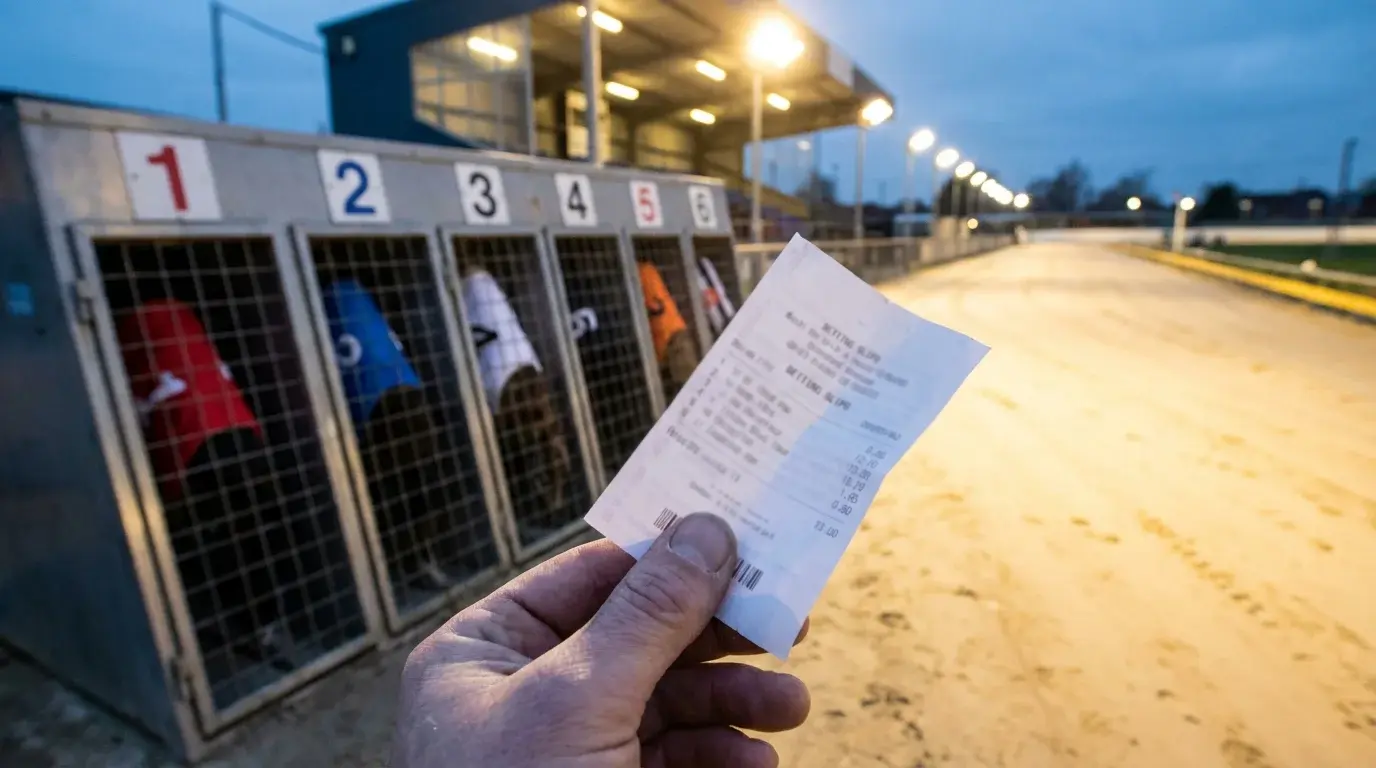
More Than Just Picking a Winner
Most people at the dogs bet on a name they like. That’s fine — but there are smarter options. Greyhound racing offers a wider range of bet types than most casual punters realise, and choosing the right one for a given race can be the difference between a missed opportunity and a meaningful return.
A six-dog field creates a compact market where the relationship between runners is easier to assess than in a twenty-horse handicap. You can often form a strong opinion on which two dogs will fill the first two places without being certain which one crosses the line first. That’s not a weakness in your analysis — it’s a prompt to use a forecast rather than a win bet. Similarly, if you fancy a dog at long odds but can’t justify the risk on a straight win, an each-way bet restructures the wager so a place finish still returns a profit. The bet type you choose shapes the bet itself.
This guide covers every standard greyhound bet type available at UK bookmakers and on-course tote windows: win, place, each way, straight forecast, reverse forecast, combination forecast, tricast, combination tricast, accumulator, and a handful of speciality markets. Each one is explained with a worked example using realistic odds, so you can see exactly how stakes translate into returns. The goal is not to tell you which bet to place — that depends on the race, the card, and your own judgement — but to make sure you understand every option before the traps open. Because in greyhound betting, the punter who knows all the available tools will always outperform the one who only knows how to back a winner.
Common Greyhound Bets: Win, Place, Each Way
These three bets are the foundation of every greyhound punter’s toolkit. They’re the simplest to understand, the quickest to place, and the ones you’ll use most often whether you’re betting through an app or at the tote window trackside. Every other bet type on this page is built on or around these basics, so getting them right matters.
Win Bets and When to Use Them
A win bet is exactly what it sounds like: you back a dog to finish first. If it wins, you collect. If it finishes second or worse, you lose your stake. There are no consolation prizes and no partial returns.
The simplicity is the appeal — and the risk. In a six-runner field, the average implied probability of any one dog winning (if all were equal) would be roughly 16.7 percent. They’re never equal, of course, so favourites might be priced at odds implying a 40 to 50 percent chance, while outsiders sit at 8 to 10 percent. A win bet on a short-priced favourite offers a higher probability of collecting but a smaller return. A win bet on a long shot offers the reverse.
Win bets work best when you have a strong, singular view. If after studying the racecard you believe one dog has a clear advantage — the right trap, the best recent time, solid form at this track — a win bet expresses that opinion cleanly. If your view is less definitive, other bet types may serve you better.
Place Betting on Greyhounds
A place bet backs a dog to finish in the top two in a standard six-runner race. The terms vary slightly depending on the number of runners — in races with fewer than five runners, place betting may not be available — but at most UK fixtures the standard place terms for greyhound racing are first or second.
Place bets pay at a fraction of the win odds, typically one quarter of the displayed price, per the standard industry place terms for races with five to seven runners. So a dog at 8/1 to win would pay 2/1 for a place. The reduced return reflects the higher probability of collecting: finishing in the top two out of six is considerably more likely than winning outright, and the odds adjust accordingly.
Place betting suits two scenarios. First, when you believe a dog is competitive but not necessarily the best in the field — good enough to hit the frame but probably not good enough to win. Second, when you want to reduce variance across a night’s betting, accepting smaller returns in exchange for a higher strike rate. Professional greyhound bettors often use place bets on long-priced runners where the place fraction still offers genuine value.
Each-Way Betting: How Place Terms Work
An each-way bet combines a win bet and a place bet in a single wager. Your stake is doubled — half goes on the win, half on the place. If the dog wins, both parts pay out: the win half at full odds and the place half at the reduced place fraction. If the dog finishes second, you lose the win half but collect on the place half. If the dog finishes third or worse, you lose both.
In greyhound racing, place terms are almost always one quarter of the win odds for the first two finishers. So a five-pound each-way bet at 6/1 means you stake ten pounds total: five on the win at 6/1 and five on the place at 6/4 (one quarter of 6/1). If the dog wins, you receive thirty-five pounds from the win part (thirty pounds profit plus five pounds stake back) and twelve pounds fifty from the place part (seven pounds fifty profit plus five pounds stake back), for a total return of forty-seven pounds fifty on a ten-pound total stake — a net profit of thirty-seven pounds fifty. If the dog finishes second, you receive twelve pounds fifty from the place part only, for a net profit of two pounds fifty overall.
Each-way betting is most effective at longer odds. At very short prices — say, evens or shorter — the place return is so small that the doubled stake rarely justifies the structure. The sweet spot for each-way greyhound bets typically sits between 4/1 and 10/1, where the place fraction offers a meaningful return without requiring a win to break even.
Forecast and Tricast Bets
Forecasts and tricasts are where the bigger dividends live. These bet types require you to predict not just a winner but the exact order of the first two or three finishers. The difficulty is higher, but the returns reflect it — forecast dividends routinely pay multiples of what a straight win bet would return, and tricast payouts can run into the hundreds from a modest stake.
Straight Forecast Explained
A straight forecast requires you to name the first and second dog in the correct order. If you select Dog A to win and Dog B to finish second, only that exact outcome pays. Dog B winning with Dog A second is a losing bet. The precision demanded is what drives the price up.
Forecast dividends in greyhound racing are calculated by the tote on a pool basis (for tote forecasts) or paid at an industry-calculated dividend (for bookmaker forecasts). The payout depends on the odds of both dogs and the finishing order. As a rough illustration, if the favourite at 2/1 wins and a 5/1 shot finishes second, the forecast dividend might be around fifteen to twenty pounds for a one-pound stake. If the positions are reversed — the longer-priced dog wins — the dividend is typically higher because the market considered that sequence less likely.
Straight forecasts work best when you have a confident view of the winner and a clear second pick. The racecard analysis matters more here than for a simple win bet because you’re not just identifying the best dog — you’re assessing the relative merits of the remaining five and narrowing to one for the runner-up spot. Sectional times, trap draw, and running style all feed into this. A confirmed front-runner drawn inside with a fast closer drawn outside is a natural straight forecast structure: leader first, closer second.
Reverse Forecast and Combination Forecast
A reverse forecast covers both possible finishing orders for two selected dogs. You pick Dog A and Dog B, and you win if either finishes first with the other second. In practice, this is two straight forecasts in a single bet, so your stake is doubled. If you put two pounds on a reverse forecast, you’re placing one pound on A first / B second and one pound on B first / A second.
Reverse forecasts are useful when you’re confident that two specific dogs will dominate but can’t separate them. Maybe both have strong recent form, similar times at the track, and drawn in favourable traps. Rather than committing to one finishing order, you cover both. The trade-off is the doubled stake, which means the dividend needs to be large enough to return a profit after covering both lines.
A combination forecast extends the principle to three or more selections. If you pick three dogs (A, B, and C) in a combination forecast, you’re covering every possible first-and-second pairing: A/B, B/A, A/C, C/A, B/C, and C/B — six combinations. A one-pound combination forecast on three dogs costs six pounds. On four dogs, it would be twelve lines and twelve pounds. The coverage increases your chances of landing the forecast but dilutes your return per unit staked. Combination forecasts make sense in open races where the form suggests three or four genuine contenders and the likely dividend is high enough to absorb the multi-line cost.
Tricast and Combination Tricast
A tricast requires naming the first three finishers in exact order. In a six-dog race, there are 120 possible permutations for the first three places, which tells you immediately why tricast dividends can be substantial. Even when the three shortest-priced dogs fill the frame, a tricast often returns significantly more than a simple win bet on the favourite.
The calculation mechanics work similarly to forecasts but with an added layer of complexity. Tote tricasts are pool-based, while bookmaker tricasts use an industry standard algorithm. In either case, the dividend is determined by the starting prices of the three dogs and the finishing order. An unexpected result — a 10/1 shot winning with two 4/1 shots filling the places — can generate dividends of several hundred pounds to a one-pound stake.
Combination tricasts follow the same logic as combination forecasts: you select three or more dogs and cover every possible ordering of the top three. Three dogs produce six tricast lines. Four dogs produce twenty-four. The stakes escalate quickly, so this bet type requires either discipline in selection or an acceptance that you’re paying for broad coverage. The most common approach among experienced greyhound punters is to select three dogs for a six-line combination tricast, keeping the total outlay manageable while still capturing any order those three might finish in.
Accumulator and Multi-Bet Options
Greyhound accumulators offer enormous potential returns — and an enormous probability of losing. An accumulator (or acca) links multiple selections across different races into a single bet. All selections must win for the bet to pay out. The winnings from the first selection roll into the second, the second into the third, and so on, which is how a modest stake can produce a headline return. It’s also how most accumulators end in a loss.
The maths is seductive. A four-fold accumulator on four dogs each priced at 3/1 returns 255 pounds from a one-pound stake if all four win. That’s a striking number, and bookmakers promote greyhound accumulators heavily because they know the true probability of landing one is far lower than most punters estimate. The implied probability of four independent 3/1 winners all coming in is roughly 0.4 percent — that’s (0.25)⁴. That means you’d expect to lose this bet about 99.6 times out of 100.
None of this makes accumulators inherently wrong — but it does make them inherently high-variance. If you’re placing a five-pound accumulator for entertainment with money you’d happily spend on a pint, that’s a legitimate use of the bet type. If you’re regularly staking significant portions of your bankroll on accumulators hoping for a life-changing return, you’re on a path that leads to empty accounts rather than full ones.
Double and treble bets — two and three selections respectively — sit at the more sensible end of the accumulator spectrum. A double links two selections and pays out if both win. The probability of success is higher than a four- or five-fold, and the returns are still noticeably better than two separate win bets placed individually. Trebles extend to three legs and offer a middle ground between the modest returns of singles and the lottery-ticket odds of longer accas.
One practical consideration: greyhound racing produces results every fifteen minutes at a busy fixture. The temptation to add “one more leg” to an accumulator is constant, and each additional leg roughly halves your probability of collecting. Experienced punters who use accumulators tend to set a firm rule — doubles only, or trebles at most — and treat anything longer as a recreational flutter rather than a strategic bet. The discipline to stop adding legs is more valuable than any selection skill when it comes to multi-race betting.
Trap Challenge and Speciality Markets
Beyond the standard markets, bookmakers offer a few niche options that cater to punters looking for something different. These speciality bets aren’t available at every fixture, and they don’t suit every race, but they add variety and occasionally surface genuine opportunities that the main markets miss.
The trap challenge is the most common speciality market. It allows you to bet on a specific trap number to produce the most winners across an entire meeting. Rather than picking individual dogs, you’re backing the trap position itself. If trap two produces four winners and no other trap produces more than three, anyone who backed trap two for the meeting collects. It’s a macro bet that relies on trap bias data across a venue’s full card rather than race-by-race analysis.
Trap challenges appeal to punters who track venue-level statistics. Some tracks show a measurable long-term advantage for inside traps, particularly over shorter distances. If the data supports a bias, the trap challenge is a way to monetise it without needing to pick individual winners. The catch is that a single meeting is a small sample — trap bias plays out over hundreds of races, and any given night might deviate from the trend. It’s a bet best used when historical data is strong and the meeting has enough races to give the bias a chance to assert itself.
Other speciality markets include match bets, where a bookmaker prices up two specific dogs against each other and you simply pick which one finishes higher regardless of overall finishing position. Match bets eliminate the wider field from your analysis and reduce the wager to a head-to-head assessment. They’re useful when you have a clear opinion on two dogs but no view on the other four.
Some bookmakers offer insurance specials — money-back if your dog finishes second to the favourite, for instance, or a free bet refund if your selection is beaten by less than a length. These promotions change regularly and are worth monitoring, though the terms always favour the bookmaker on aggregate. Treat them as a small bonus to your existing strategy rather than a reason to alter your selections.
Speciality markets carry one consistent risk: lower liquidity and less competitive pricing than the main win and forecast markets. Because fewer punters bet on them, the margins can be wider and the value harder to find. Use them selectively, when the situation fits, rather than as a default.
Which Bet Type Suits Your Approach?
Your bet type should match your level of confidence. That sounds obvious, but in practice most greyhound punters default to the same bet type regardless of the race, the card, or their own analysis. They back a win single every time, or they always do a forecast, or they always go each way. Consistency in staking is a virtue. Rigidity in bet selection is not.
Think of it as a decision tree rooted in how much you actually know about the race. If you’ve studied the racecard and one dog stands out — clear best recent time, favourable trap, no obvious dangers — a win single is the clean expression of that opinion. You’ve done the work, you’ve reached a conclusion, and the bet matches it. The odds might be short, but if the probability is genuinely in your favour, the win bet captures the full value of your assessment.
If your analysis identifies two dogs that look clearly superior to the rest but you can’t confidently separate them, you’ve arrived at forecast territory. A reverse forecast covers both finishing orders and costs twice the stake, but it’s more honest than forcing a win bet on a race you can’t fully read. The same logic extends to tricasts when three dogs separate themselves from the field. The bet type should reflect the shape of your opinion, not force your opinion into an arbitrary shape.
Each-way bets suit a specific scenario: you fancy a dog at decent odds but acknowledge significant risk. Maybe the trap isn’t ideal, or the form is good but not dominant. The each-way structure gives you a return for a place finish, which softens the downside while preserving the upside. It’s a hedge, and there’s nothing wrong with hedging when the situation warrants it — the key is reserving it for the right odds range, as covered earlier.
Accumulators and multi-bets suit punters who accept high variance and treat the bet as a recreational add-on to their main activity. They don’t suit anyone trying to build a sustainable approach to greyhound betting. If you’re serious about long-term results, your core betting should consist of singles, each-way bets, and selected forecasts. Accumulators can sit alongside those as a small, controlled indulgence — not as the main event.
One framework that experienced punters use: before placing any bet, state to yourself what you believe and how strongly you believe it. “I think this dog wins” points to a win bet. “I think these two fill the first two spots” points to a forecast. “I think this dog runs well but might not win” points to each way or place. “I think this is a competitive race and I’m not sure” points to no bet at all. Matching the bet type to the belief — rather than reaching for the same bet every time — is one of the quieter skills in greyhound betting, and one of the most profitable.
Calculating Returns: A Quick Reference
Before you place any bet, you should know what your return looks like. Not approximately. Exactly. Greyhound odds in the UK are most commonly displayed in fractional format, and converting those fractions into actual pounds returned is the basic arithmetic of betting. If you can’t do it quickly, you can’t assess whether a bet offers value — and value is the entire game.
A win bet at fractional odds is straightforward. The fraction tells you the profit relative to your stake. At 5/1, you win five pounds for every one pound staked. At 7/2, you win seven pounds for every two pounds staked — or three pounds fifty for a one-pound bet. Your total return always includes your original stake, so a one-pound bet at 5/1 returns six pounds total: five profit plus one stake back. At 7/2, a one-pound bet returns four pounds fifty: three fifty profit plus one pound stake.
For decimal odds, which some online platforms display by default, the calculation is simpler. Decimal odds already include the stake in the figure. Odds of 6.00 mean a one-pound bet returns six pounds total. To convert fractional to decimal, divide the first number by the second and add one. So 5/1 becomes (5 ÷ 1) + 1 = 6.00. And 7/2 becomes (7 ÷ 2) + 1 = 4.50.
Each-way returns require two calculations. Take a five-pound each-way bet on a dog at 8/1 with standard greyhound place terms (one quarter odds, first or second). Your total stake is ten pounds: five on the win, five on the place. If the dog wins, the win part returns five pounds times 8/1 = forty pounds plus stake = forty-five pounds. The place part returns five pounds times 2/1 (one quarter of 8/1) = ten pounds plus stake = fifteen pounds. Total return if the dog wins: sixty pounds on a ten-pound stake, giving fifty pounds profit. If the dog finishes second, only the place part pays: fifteen pounds returned on a ten-pound stake, for five pounds profit. If the dog finishes third or worse, you lose the full ten pounds.
Forecast returns are harder to calculate in advance because the dividend is determined after the race, either by the tote pool or by industry calculation. You can estimate the range by looking at the odds of your two selected dogs. If both are short-priced, expect a modest forecast dividend. If one or both are at bigger odds, the dividend climbs. As a very rough guide, multiplying the win odds of both dogs gives you a ballpark, though the actual dividend can be higher or lower depending on the pool or the calculation method. A one-pound forecast on a 3/1 shot finishing first and a 5/1 shot second might return somewhere in the range of fifteen to twenty-five pounds, but this is an approximation — actual dividends vary considerably.
Tricast dividends follow the same principle but with three runners, producing higher and more volatile returns. There’s no reliable shortcut for pre-calculating tricast payouts, which is why most punters who bet tricasts regularly treat them as high-reward speculative bets rather than precisely valued wagers.
Accumulator returns compound across legs. A three-leg acca at 2/1, 3/1, and 4/1 returns: (3.00 × 4.00 × 5.00) = 60.00 in decimal odds, meaning a one-pound stake returns sixty pounds. Each leg multiplies the previous running total, which is why accumulators produce eye-catching figures — and why one losing leg zeroes the whole bet.
The single most practical habit you can develop is running the return calculation before you place the bet, not after. Knowing your exact exposure and your exact potential return is the minimum standard for informed betting. Every bookmaker app has a built-in calculator in the bet slip, but understanding the maths yourself means you catch errors, spot value, and never have to wonder what you’re actually risking.
The Bet You Didn’t Place: Knowing When to Pass
The most profitable bets are sometimes the ones you walk away from. This is especially true in greyhound racing, where fixtures run daily and there’s always another race in fifteen minutes. The constant availability of betting opportunities is a structural feature of the sport, and it’s designed — whether intentionally or not — to keep punters engaged and staking. Recognising when a race doesn’t offer a worthwhile bet is a skill that takes longer to develop than any form-reading technique, but it pays for itself repeatedly.
Not every race on the card presents a clear angle. Sometimes the form is ambiguous, the trap draws are awkward, and none of the six runners separate themselves on the data. Betting into that kind of race is a coin-flip dressed up as analysis. It doesn’t matter how many bet types you understand or how well you calculate returns — if the underlying selection has no foundation, the bet is speculation. And speculation across hundreds of bets tends toward the bookmaker’s margin rather than the punter’s pocket.
The discipline to pass a race is harder than it sounds. When you’ve spent five minutes studying a racecard and found nothing conclusive, the temptation is to force a selection anyway — to justify the time spent. Resist it. The time spent studying and deciding not to bet was not wasted. It was filtering. The races you do bet on after proper analysis will benefit from the same rigour that led you to skip the ones you couldn’t read.
A useful habit is to set a pre-session rule: decide in advance how many races you’ll bet on across a meeting, and stick to it. If a meeting has twelve races, committing to bet on no more than three forces you to prioritise — and prioritising means only acting on your strongest opinions. The other nine races become research opportunities, not betting obligations.
Greyhound betting rewards patience more than most punters expect. The calendar is year-round, fixtures are daily, and the opportunities never stop arriving. That permanence should make passing easier, not harder, because the next good race is always coming. The punters who last longest and profit most consistently are not the ones with the highest strike rate or the biggest single-night haul. They’re the ones who learned to sit out the races that didn’t fit and save their stake for the ones that did. Every bet type in this guide is a tool. Knowing when not to use any of them is the skill that ties the toolkit together.
