

- Why the Racecard Is Your Most Important Betting Tool
- Anatomy of a Greyhound Racecard
- How to Read Greyhound Form Figures
- Sectional Times and What They Reveal
- Trap Statistics and Track-Specific Data
- Trainer and Kennel Form on the Card
- Putting It All Together: A Racecard Walkthrough
- Beyond the Printed Numbers: What the Racecard Can’t Tell You
Why the Racecard Is Your Most Important Betting Tool
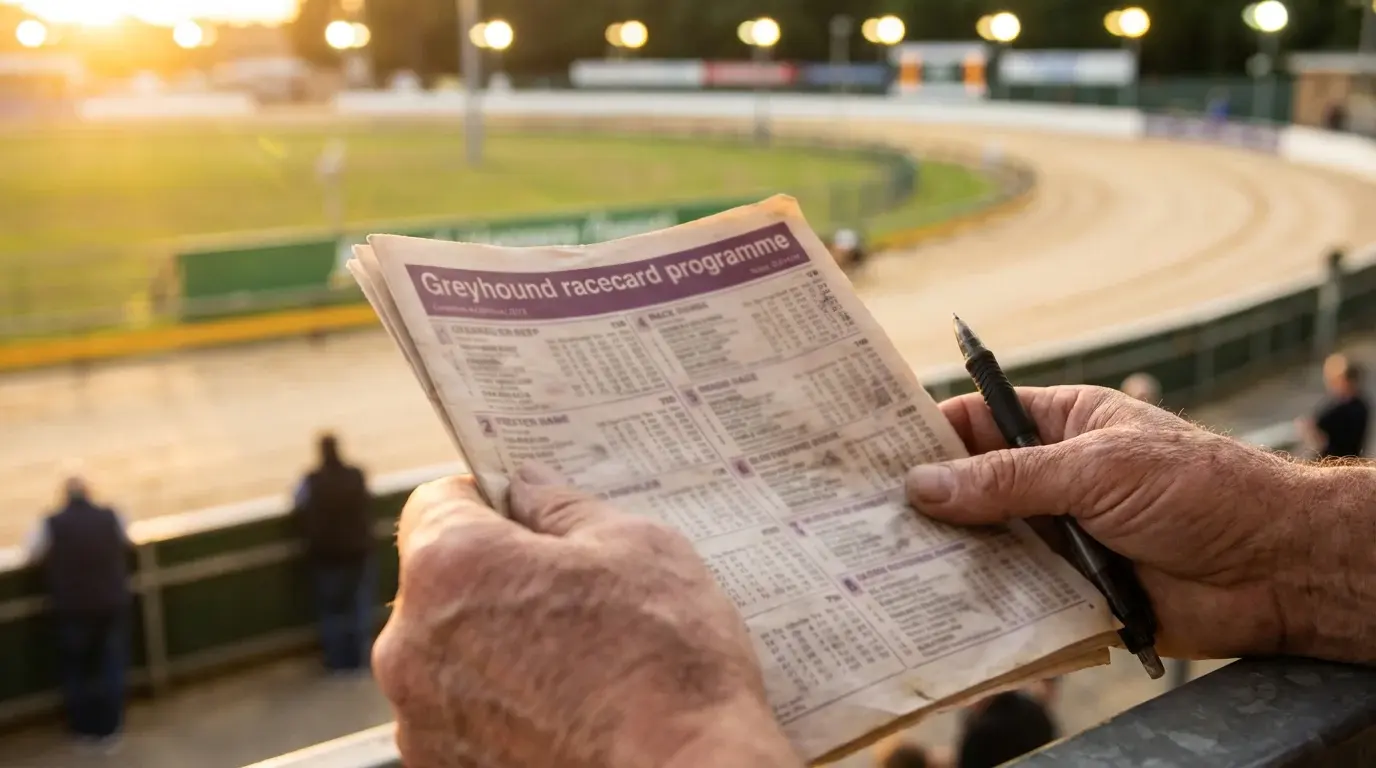
Ignore the racecard and you’re betting blind. That’s not a metaphor — it’s arithmetic. A greyhound race features six dogs running around a sand track for roughly thirty seconds, and without the racecard, all you’ve got to separate them is a name and a jacket colour. That’s enough for a coin flip. It’s nowhere near enough for a bet worth placing.
The racecard is the single document that compresses everything the sport knows about each runner into a few lines of data. Recent form, trap record, weight, trainer, sectional times, grade, distance preference — it’s all there, condensed into a format that fits on a phone screen or a printed programme. Every bookmaker in the UK publishes racecards before every greyhound fixture. Timeform, the Racing Post, and the tracks themselves offer them for free — Towcester Racecourse provides a detailed guide to interpreting their format. They’re not hidden knowledge. But most punters never learn how to read them properly, which is precisely why they’re so valuable to those who do.
Horse racing punters take the form book seriously. They study pedigree pages, going preferences, and jockey booking patterns. Greyhound punters, by contrast, often skip straight to the odds. The irony is that greyhound racecards are considerably simpler than their equine equivalent. There are fewer variables, fewer runners, and shorter form lines. You don’t need years of study to decode them — you need about twenty minutes of focused attention and a willingness to look at the data instead of guessing.
This guide strips the racecard down to its component parts. Each section covers a different element — from the basic identifiers at the top of the card to the sectional times buried further down — and explains what it means in practical betting terms. By the end, you’ll be able to pick up any racecard from any UK fixture and know exactly what you’re looking at, what matters, and what to ignore. The racecard won’t tell you who’s going to win. Nothing can do that reliably. But it will tell you who deserves your money and who doesn’t — and in greyhound betting, that distinction is where the edge lives.
Anatomy of a Greyhound Racecard
Every racecard follows the same basic template, regardless of the track or the platform displaying it. Whether you’re reading on Timeform, the Racing Post, or a bookmaker’s app, the information is presented in a consistent structure. Learn it once and it transfers everywhere. The details may vary in depth — some sources include more historical data than others — but the core layout stays the same.
A typical racecard entry for one dog includes the following elements in roughly this order: trap number, dog name, trainer, sire and dam, form figures, best recent time, weight, sectional times, grade, and running comments. Some racecards add trap statistics, kennel form indicators, or star ratings from tipsters, but those are extras. The essentials listed above appear on every card. Let’s work through them from the top.
Dog Name, Trainer, and Sire/Dam Lines
The dog’s name appears first, usually in bold. Underneath or beside it you’ll find the trainer’s name, which is more useful than most punters realise — a point we’ll return to later. The sire and dam lines tell you the dog’s parentage. In horse racing, breeding analysis is practically its own industry. In greyhound racing, it matters less at graded level but becomes more relevant in open races and major competitions where the field quality is higher. For standard BAGS fixtures, you’re unlikely to gain a meaningful edge from pedigree alone, but it’s worth noting when a dog is bred from lines associated with stamina or early pace. If two dogs look similar on form, their breeding can sometimes be the tiebreaker.
Trap Number and Jacket Colour
The trap number — one through six — is assigned by the racing office, not chosen by the trainer. Each number corresponds to a specific jacket colour: red for trap one, blue for two, white for three, black for four, orange for five, and striped (black and white) for six. These colours are specified in GBGB Rule 118 and exist so spectators and camera operators can identify dogs during a race that lasts under half a minute.
For betting purposes, the trap number is not cosmetic. It determines where on the track the dog starts, which directly affects its route through the first bend. Inside traps (one and two) favour railers — dogs that hug the rail and take the shortest path. Outside traps (five and six) suit wide runners who need room to stride out without getting boxed in. A dog with strong form from trap one might struggle if switched to trap six at the same track, and the racecard will often show this in the trap-specific statistics further down. Never treat the trap number as a random detail. It’s a tactical assignment, and it shapes the race before the hare even moves.
Weight and Season Status
Every dog is weighed before racing, and this weight is printed on the card. The number itself is less important than the trend. A dog that has gained or lost a kilogram over its last three runs might be in different physical condition than the last time it ran. Sharp weight drops can signal a dog that has been trialled hard, while a gradual increase might suggest a dog building condition after a break. Look at the weight alongside recent results — a dog running well and holding steady weight is generally in good nick.
Season status applies to female greyhounds. A bitch that has recently been in season will typically have had a break from racing and may return in different form. Some racecards mark this with a small symbol or abbreviation. If you see an “s” or a note indicating the dog was last raced several weeks ago with no intervening trials listed, season absence is one possible explanation. It’s not automatically a negative — some bitches return from season in sharper condition — but it introduces uncertainty, which is something you should weigh into your assessment rather than ignore.
How to Read Greyhound Form Figures
Form figures are a compressed race replay. Each line of form on a racecard represents one previous race, and the figures encode what happened at every stage. If you can decode these lines quickly, you can reconstruct how a dog ran its last few races without ever watching the footage. That’s the skill that separates punters who study form from those who just glance at finishing positions.
Position Numbers and What They Mean
The most prominent feature of a form line is a string of numbers, typically between three and six digits depending on the racecard provider. These represent the dog’s position at specific points during the race: out of the traps, at the first bend, at the second bend, at the third bend (if applicable for the distance), and at the finish.
For example, a form line reading “3 2 1 1” tells you the dog broke third out of the traps, moved up to second by the first bend, hit the front by the second bend, and won the race. That’s a dog with mid-race pace and the ability to sustain it. Compare that with “1 1 1 2” — a dog that led from the start but was caught in the closing stages. Same finishing position isn’t on the cards here; the first dog is a closer, the second is a front-runner who faded. Those are fundamentally different racing profiles, and the form figures make the distinction in four digits.
A figure of “6 6 6 5” doesn’t necessarily mean the dog is slow. It might have been badly hampered at the first bend, lost all position, and still managed to pass one rival late on. That’s why the running comments matter — but on pure numbers alone, a string of sixes looks terrible while potentially hiding a dog that was simply unlucky. Context always modifies the headline numbers.
Running Comments and Abbreviations Decoded
Alongside the positional numbers, most racecards include a short running comment describing what happened during the race. These are written in a compressed shorthand that takes a moment to learn but becomes second nature fast. Common abbreviations include: “EP” for early pace (the dog showed speed from the traps), “SAw” for slow away (missed the break), “Bmp1” for bumped at the first bend, “Ld2” for led at the second bend, “RnOn” for ran on (finished strongly), “Crd” for crowded, and “Wide” for ran wide throughout.
The comments add the narrative that the numbers leave out. A dog finishing fourth with “Bmp1, Crd2, RnOn” had trouble early, got squeezed in the middle of the race, and still finished with effort. That’s a far more encouraging run than a dog finishing fourth with “EP, Ld1, Fdd” — which translates to early pace, led at the first bend, then faded. The first dog was unlucky; the second couldn’t sustain its speed. The finishing positions are identical. The stories are not.
Pay particular attention to “SAw” (slow away) in sprint races. Over 210 or 270 metres, a dog that misses the break by even a length may never recover. But in longer races — 480 metres and above — slow-away comments are less damning because there’s time to make up the ground. Distance changes the significance of almost every abbreviation.
Distance and Going Information
Each form line specifies the distance of the race and the track condition, known as the going. In greyhound racing, all UK tracks now use sand surfaces, but the going can vary from fast to slow depending on moisture levels. A dog that posted quick times on fast going may run a second or two slower when the sand is wet and heavy. If you’re comparing form lines from different fixtures, always check whether the going was consistent. A time of 29.50 seconds over 480 metres on fast going is a different performance than 29.50 on slow going — the latter is actually the more impressive run.
The distance field tells you whether the form is relevant to the current race. A dog with five recent runs over 480 metres entered in a 480-metre race gives you directly comparable data. A dog with recent form over 640 metres stepping down to 480 is a different proposition — it may have the speed for the shorter trip, or it may lack the early pace that sprint-distance racing demands. Form figures from a different distance are useful context but should never be treated as like-for-like.
One more detail worth catching: the finishing distance. Many racecards note how far behind the winner each dog finished, expressed in lengths. A dog beaten two lengths in a graded race may still be competitive next time, while a dog beaten eight lengths is either outclassed or had a troubled run. Match the finishing distance to the running comments and you start building a genuine picture of ability rather than just results.
Sectional Times and What They Reveal
Sectional times break a race into its component parts. Instead of one overall time from trap to line, sectional data tells you how fast a dog ran each phase of the race — typically split into the run to the first bend, the middle section, and the closing phase. Not every racecard includes sectionals, but when they’re available, they’re among the most revealing numbers on the entire card.
The first sectional — the time from the traps to the first timing point — measures raw early pace. A dog that consistently posts quick first-sectional times is one that breaks sharply and takes up a forward position. In sprint races, this figure is almost everything: a dog with the fastest first sectional wins from the front more often than not, because there simply isn’t enough race left for slower starters to recover. In standard-distance races over 480 metres, the first sectional still matters, but the middle and closing splits gain importance. A dog that records modest early splits but finishes with the fastest final sectional is a closer — a dog that comes from off the pace and picks up tired rivals in the run to the line.
Comparing sectional profiles between dogs in the same race is where this data becomes genuinely useful. If you identify that three of the six runners are front-runners with fast early splits but fading finishes, you can anticipate crowding at the first bend and a fast early tempo that may set up a strong closer drawn in a favourable trap. That’s not a guarantee, but it’s a structural read of the race that most punters never make because they only look at overall times and finishing positions.
There’s a common mistake worth flagging: treating sectional times as absolute benchmarks. They’re not. Sectional timing points differ slightly from track to track, and conditions on the night affect all dogs equally. A fast first sectional at Romford isn’t directly comparable to a fast first sectional at Monmore because the track geometries are different. Use sectionals to compare dogs within the same race, not across different venues. Within a single race at a single track, the dog with the best final sectional across recent runs is the one with the strongest finishing kick. The dog with the best first sectional is the likeliest leader. When those are two different dogs, you’ve got a race with pace and pressure — and that’s when forecasts become interesting.
If you’re using a racecard platform that provides sectional data, make it a default part of your analysis. Overall finishing time tells you the end result. Sectionals tell you how the dog got there — and in greyhound racing, how a dog runs is often more predictive than where it finishes.
Trap Statistics and Track-Specific Data
A dog’s record from trap three at Romford tells a different story than its record at Sheffield. That’s because every track has its own geometry — different bend radiuses, different distances from trap to first bend, different widths — and each of these physical features affects which trap positions produce the best results. Flat statistics that say “trap one wins most often across UK greyhound racing” are technically true in aggregate but practically useless at individual venues where the bias might run the other way.
Most detailed racecards include a dog’s trap-specific record at the track where it’s racing. This might appear as something like “T3: 6 runs, 2 wins, 28.85 best” — telling you the dog has run from trap three at this particular venue six times, won twice, and posted a best time of 28.85 seconds. That’s directly relevant information. If the same dog is now drawn in trap three again and its best time from that box is competitive with the other runners, you have a quantified track-and-trap record to work with rather than a vague impression.
Where trap statistics become particularly useful is in spotting dogs drawn in unfamiliar traps. A dog with fifteen runs from traps one and two but none from trap five is stepping into unfamiliar territory. Its overall form might be strong, but you’re introducing an unknown — and unknowns should either be priced into your assessment or used as a reason to look elsewhere. The racecard won’t always spell this out for you, but a quick scan of the trap history will make it obvious.
Track-specific data goes beyond traps. Some racecards show a dog’s full record at the venue: total runs, wins, places, best time over the distance, and average finishing position. This is especially important for dogs that travel between tracks. A dog based in the Midlands that regularly races at Monmore but occasionally ships to Nottingham may have a dramatically different record at the two venues. The track it knows well is where its form is most reliable. At an unfamiliar track, it’s adjusting to different bends, different sand depth, and different hare timing, any of which can disrupt a dog that looks excellent on paper.
One practical rule: give more weight to recent form at the same track than to older form at a different track, even if the older results look better. A dog that won three times at Crayford six months ago but has run four unremarkable races at Romford in the last month is a Crayford specialist struggling with the switch. The racecard data supports this reading, but only if you look at the venue column alongside the results column. Many punters skip this, treating all form as interchangeable regardless of where it was produced. That’s a free edge for anyone who doesn’t make the same mistake.
Trainer and Kennel Form on the Card
Trainer patterns are one of the most underused angles in greyhound betting. Every dog on the racecard is listed with its trainer, and while this might look like a bureaucratic detail, it carries real predictive value — particularly at track level, where certain trainers dominate specific venues and distances.
In greyhound racing, the trainer is closer to a horse racing trainer and jockey combined. They manage the dog’s fitness, decide which races to enter, and oversee day-to-day conditioning. A trainer who consistently wins at a particular track knows how to prepare dogs for its distances, bends, and surface. Their runners at that venue deserve more respect than their runners elsewhere, all else being equal. Some trainers specialise in sprinters; others excel with stayers. Some are known for peaking dogs at the right moment for a major competition; others maintain steady form across BAGS fixtures week after week.
Kennel form — the recent win rate and place rate across all dogs in a trainer’s yard — is a useful secondary indicator. If a kennel is hitting at 30 percent or above over the last fortnight, the dogs in that yard are generally in good condition and well prepared. If the kennel strike rate has dropped sharply, it could signal illness, surface issues at their home trialling ground, or simply a rough patch. You can’t build a strategy solely on kennel form, but it adds another filter to your racecard analysis. A dog with decent individual form from a kennel on a hot streak is a stronger proposition than the same dog from a kennel going through a bad run.
Where trainer data really earns its place is in open races and feature events. At graded level, the field is assembled by the racing office based on times and grades, and the trainer’s influence is mainly in fitness and trap preference requests. In open races and major competitions, trainers choose which events to target and often have more flexibility in selecting optimal conditions. The best trainers campaign their dogs strategically, and if you track which trainers tend to target which races, you’ll start spotting entries that are more significant than they first appear.
Not every racecard platform displays trainer strike rates prominently. Timeform includes it in their detailed view. The Racing Post’s greyhound section also carries trainer statistics. If your preferred platform doesn’t show it, consider cross-referencing with one that does — the half-minute it takes to check a trainer’s recent form can reframe how you view an entire race.
Putting It All Together: A Racecard Walkthrough
Let’s take one race — six dogs — and read the card from scratch. This is a fictional A3 graded race over 480 metres at a standard UK track, but the process is identical for any real fixture you’ll encounter. We’ll work through it the way a methodical punter would, treating the racecard as a working document rather than a glance-and-guess exercise.
Start with the trap draw. Scan all six runners and note which dogs have recent form from their drawn trap at this track. If the dog in trap one has run from trap one here four times with two wins and a best time two lengths faster than the field, that’s a significant advantage. If the dog in trap six has never run from an outside box at this venue, that’s an uncertainty worth noting. Two minutes into the exercise and you’ve already narrowed the field from six into categories: confirmed in trap, unproven in trap, and disadvantaged by trap.
Next, read the form figures for the last three runs of each dog. Ignore the finishing position for a moment and focus on the positional sequence. Which dogs show early pace? Which ones consistently improve through the race? Are there any patterns of trouble — repeated “Bmp1” or “Crd” comments that suggest a dog prone to first-bend interference? In a six-dog field, collisions at the first bend are common, and a dog that has been bumped in three of its last four runs is either unlucky or running a line that invites contact. Either way, it’s a risk.
Now compare times. Look at each dog’s best recent time over the distance at this track. If one dog has posted 28.80 and the rest are clustered around 29.20 to 29.40, that’s a half-second margin — roughly three to four lengths — which is substantial. But check the context: was that 28.80 run on fast going when tonight’s conditions are standard? Was it from a favourable trap that the dog doesn’t have tonight? Raw times without context mislead more often than they inform.
Cross-reference with sectional data if available. The dog with the fastest overall time might not have the best closing sectional. If a front-runner with a 28.80 best time is drawn inside and there’s a confirmed closer with a strong final split drawn outside, you can model two realistic outcomes: the front-runner leads throughout and holds on, or the closer navigates the bends and picks it up late. That’s a forecast bet waiting to happen rather than a straight win selection.
Check the weights. Any significant change in the last two to three runs? A loss of half a kilo or more might indicate hard training or illness. A gain might suggest a dog freshened up after a rest. Match the weight trend to the form — a dog dropping weight while also dropping in the finishing order is flagging a potential problem. A dog gaining weight while improving suggests returning fitness.
Finally, glance at the trainer data. Is any dog from a kennel on a winning run? Is any from a trainer with a strong record at this specific venue? These aren’t decisive factors on their own, but they’re tiebreakers. When two dogs look evenly matched on form, times, and trap record, the one from a trainer in better current form gets the nod.
The entire process takes five to ten minutes per race. It sounds slow, but consider the alternative: picking a dog based on a name, a gut feeling, or the shortest odds. The racecard walkthrough doesn’t guarantee winners, but it structures your thinking and forces you to assess each runner on evidence rather than impression. Over a hundred bets, that discipline shows up in your results even if it’s invisible on any single night.
Beyond the Printed Numbers: What the Racecard Can’t Tell You
The racecard is a starting point, not a verdict. It gives you the best available data on each runner’s recent history, physical condition, and competitive context. What it cannot give you is the full picture, because certain variables never make it onto the card — and some of them matter.
Track conditions on the night are one. The racecard will list the going for previous races, but tonight’s surface is only confirmed once racing begins. If heavy rain has fallen in the hours before the meeting, the card printed that morning won’t reflect it. Similarly, the hare’s speed and consistency on the night can vary. A hare running slightly wider or tighter than usual changes bending dynamics for every runner. You can’t anticipate this from any pre-race data — it’s a live variable that only becomes visible once the first race goes off.
Another gap is what happened between races. The form figures show a dog’s last run was twelve days ago, but they don’t tell you why. It could be a planned rest, a minor injury that healed, or a trainer waiting for a specific trap at a specific track. Trial run information sometimes appears on specialist platforms, but it’s inconsistent. If a dog has trialled between races, those times and observations sit with the trainer and the track — not on your racecard.
Then there’s temperament. Some dogs are brilliant at home but lose interest away from their regular track. Others are unreliable in the traps — occasionally standing when the lids fly open, which is functionally a slow-away but without an obvious physical cause. Repeat slow-away comments in the form might hint at this, but the racecard can’t tell you whether the dog has resolved the issue or whether it’s an ingrained trait.
None of this is an argument against using the racecard. Quite the opposite. The racecard is the best tool available, and every serious punter builds their analysis on it. But knowing its limits prevents you from placing too much confidence in any single selection. The racecard tells you where a dog has been. The race itself tells you where it’s going — and sometimes those are two very different directions. Use the card to narrow the field, quantify the risk, and structure your bet. Then accept that thirty seconds of live greyhound racing will always contain an element that no printed document can capture.
