

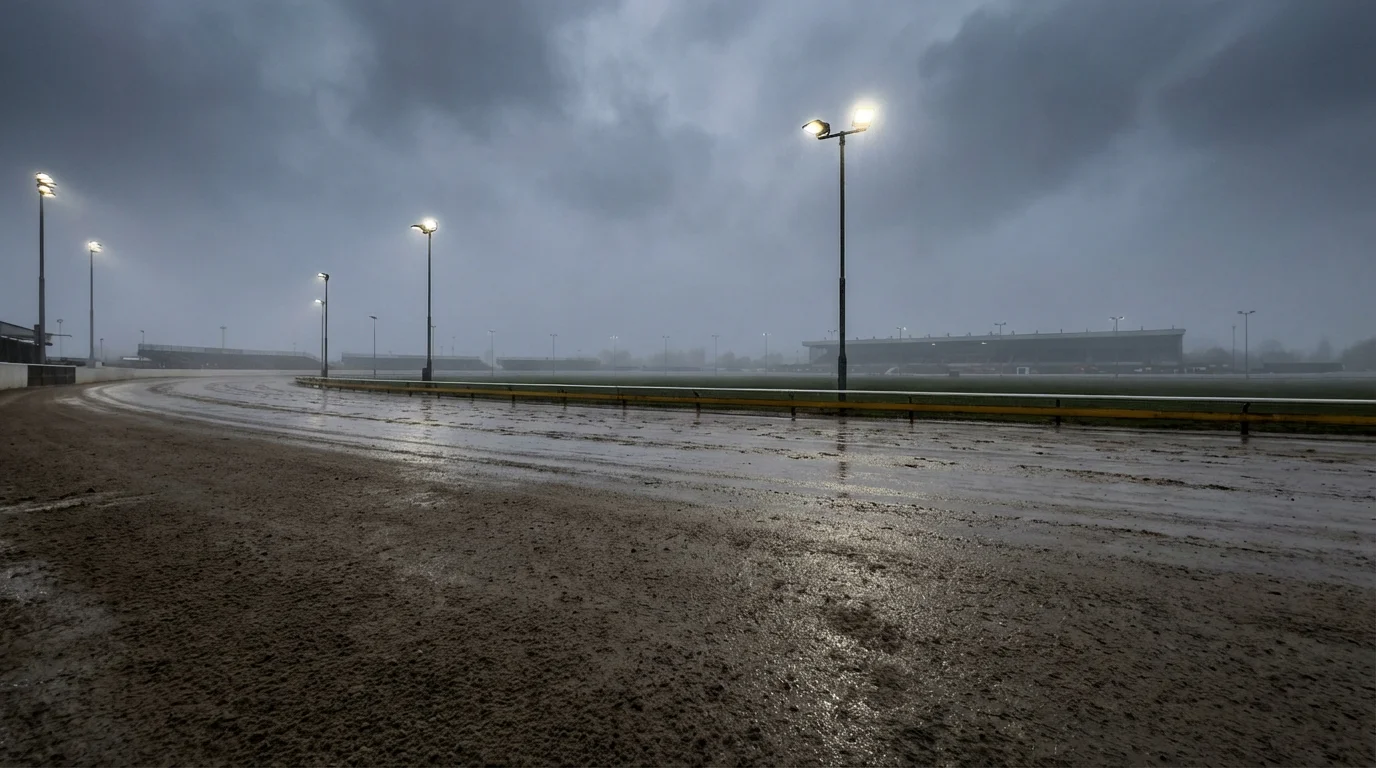
The Surface Under Their Feet
Every greyhound race is run on sand, and not all sand runs the same. The condition of the track surface — what the racing industry calls “the going” — affects race times, running styles, and the relative chances of each dog in the field. A track that ran fast and firm last Wednesday might run slow and heavy this Saturday after two days of rain. The dog that won easily on the fast surface might struggle on the slower one, and the dog that faded late last week might find the heavier going suits its grinding running style.
Going is one of the less glamorous variables in greyhound betting, but ignoring it means ignoring a factor that directly affects the outcome. You don’t need to become a track surface expert. You just need to know how conditions are described, how they change, and how to check them before you bet.
How Going Is Measured on Sand Tracks
Unlike horse racing, where the going description is a formal classification system (firm, good to firm, good, soft, heavy), greyhound racing uses a simpler approach. Tracks report their surface condition as normal, slow, or fast — sometimes with variations like “slow in places” or “normal, drying.” The description is determined by the track management based on visual inspection, recent weather, and sometimes a physical test of the sand’s moisture content.
The going description is published as part of the meeting information, typically available on the track’s website, the GBGB results service, and through major form providers. It’s updated on the day of racing, sometimes revised between the morning inspection and the start of the meeting if conditions change. After heavy overnight rain, for instance, the morning going report might read “slow” while the afternoon report, following drainage and drying, might be revised to “normal.”
Race times are the most reliable indirect measure of how the track is running. If the first three races on a card all produce times significantly slower than the grade average for that distance and track, the surface is running heavy regardless of the official description. Conversely, if times are several hundredths quicker than usual, the track is fast. Experienced punters often compare the early-race times against historical averages to calibrate the going in real time, adjusting their later selections accordingly.
Sand surfaces drain far better than turf, which is why greyhound meetings are rarely abandoned due to weather. Even after sustained rainfall, a well-maintained greyhound track can usually stage racing — the surface will be slower, but it will be safe. Frost and ice present a greater risk of cancellation, because frozen sand is dangerous for dogs running at high speed. Snow cover can also force abandonment if it can’t be cleared in time.
The depth and composition of the sand also matter, though this is managed by the track rather than something punters can directly assess. Tracks are resurfaced periodically, and a freshly laid surface might run differently from one that’s been in use for months. After resurfacing, early-race times often shift, and it takes a few meetings for the form to stabilise on the new surface.
Wet vs Dry: How Conditions Affect Performance
The difference between wet and dry sand is significant. Dry sand is looser and faster — dogs’ feet push off a firm base and the surface offers minimal resistance. Wet sand is heavier and more compacted — the moisture adds weight to every stride, slowing the overall pace and increasing the physical demands of the race.
On a fast, dry surface, early pace is king. Dogs that break quickly from the traps gain an advantage that’s hard to overcome because the surface rewards speed and efficiency. Front-runners thrive on fast going because the track is doing nothing to slow them down, and the dogs behind have to work harder to close any gap. Sprint races on fast going produce the most predictable results, with inside-drawn front-runners dominating.
On a slow, wet surface, the dynamics shift. Early speed is still important, but stamina becomes a more significant factor because the heavier ground saps energy across every stride. Dogs that lead on the fast going and hold on comfortably might tire in the final straight on slow going. Closers and stayers benefit because the front-runners are working harder and fading more, opening gaps for late finishers to exploit.
The effect is more pronounced over longer distances. In a sprint race, the time on the track is so short that going conditions have a limited impact — there’s simply not enough race for the heavy ground to drain the speed from a fast dog. Over 680 metres or further, the accumulated effect of a slow surface can change the finishing order entirely. A staying race on heavy going is a test of stamina that the standard-distance form may not predict.
Bend handling is also affected. Wet sand offers slightly more grip through the turns, which can benefit dogs that struggle with their footing on dry surfaces. Conversely, dogs that rely on agility and quick direction changes through the bends may find the heavier surface restricts their movement. These are subtle effects, but in a sport where the margin between first and fourth can be less than a length, subtle matters.
Dogs That Handle Different Going
Not every greyhound performs consistently across all surface conditions. Some dogs have a clear preference for fast going, producing their best times and finishing positions when the track is dry and running quickly. Others improve on slower ground, finding the heavier surface suits their strength-based running style. Identifying these preferences is a genuine betting edge because the market doesn’t always adjust adequately when conditions change.
The form data contains the evidence. Most racecard services record the going description alongside each race result. If a dog has six recent runs — three on normal going and three on slow — comparing the finishing positions and times across the two groups reveals any surface preference. A dog that finished 1, 2, 1 on slow going and 4, 5, 3 on normal going is clearly a wet-track specialist. Backing it on a rainy day at generous odds — because the market is focused on its mediocre recent form on faster ground — is textbook value betting.
Physical build offers some clues too, though this is less reliable than form data. Heavier, more muscular dogs sometimes handle slow ground better because their strength compensates for the additional resistance. Lighter, leaner dogs may prefer fast going where their acceleration and agility are most effective. These are generalisations, and individual dogs defy them regularly, but they provide a starting hypothesis when other data is limited.
Pedigree can also indicate surface preference. Certain sire lines are known to produce progeny that handle specific conditions better. A trainer who knows their dog’s pedigree well may target meetings when conditions suit, which is worth noting if you track trainer patterns. A trainer sending a dog to race on a wet evening when they normally rest it in poor conditions might be making a deliberate decision based on the dog’s going preference.
Checking Track Conditions Before You Bet
Checking the going should be part of your pre-bet routine, as automatic as looking at the form and the trap draw. The information is freely available and takes seconds to find.
The GBGB website and individual track websites publish going reports on race days. Most major form services — Timeform, Racing Post — display the going alongside the racecard information. If neither source has updated yet, the weather forecast for the track’s location gives you a reasonable proxy: overnight rain means slow going in the morning, and whether it dries during the day depends on temperature and wind.
For live betting during a meeting, monitor the race times from the early events. If the first two races both produce times significantly above the grade standard, the track is running slow and you should adjust your expectations for the remaining card. Dogs you expected to lead comfortably might find the pace harder to maintain. Dogs with stamina and strength might overperform their recent form. The going doesn’t just change which dogs win — it changes how the race unfolds, and your predictions should reflect that.
One practical tip: keep a simple record of your bets alongside the going description. Over a few months, you’ll start to see whether your own strike rate varies with conditions. Some bettors are unknowingly better at picking winners on fast going than slow going, or vice versa. Identifying that pattern lets you adjust your staking — betting more when conditions suit your analytical strengths and less when they don’t.
