

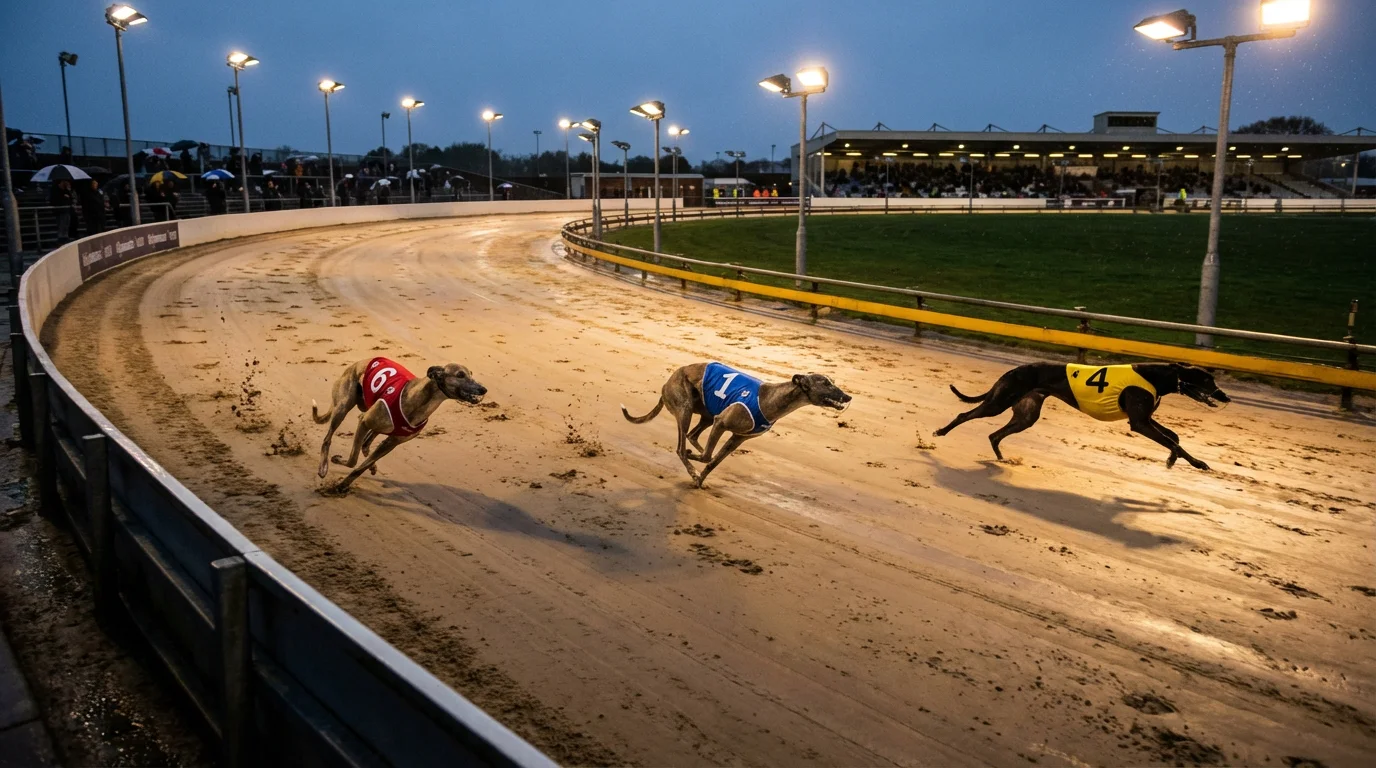
Every Dog Runs Its Own Race
Six dogs leave the traps simultaneously, but within two seconds they’ve separated into distinct racing patterns that will define the next 28 seconds. One hugs the inside rail like a train on tracks. Another swings wide through every bend, covering extra ground but finding clean air. A third breaks like a bullet and leads from start to finish. A fourth settles at the back, waiting for the runners ahead to tire before surging through late. These are running styles, and they matter as much as raw speed in determining the outcome of a greyhound race.
Running style is the intersection of a dog’s natural instincts, its physical build, and its racing experience. It’s not something a trainer chooses — it’s something a dog reveals through racing. And once a dog establishes its style, it rarely changes. A railer stays a railer. A wide runner stays wide. That predictability is precisely what makes running style so useful for bettors: it tells you where each dog will be at every stage of the race before the traps even open.
What Are the Main Running Styles?
Greyhound running styles fall into four broad categories, though many dogs show characteristics of more than one. The categories are front-runners, closers, railers, and wide runners. The first two describe when a dog is at its strongest during a race. The second two describe where it prefers to run on the track. A dog can be both a front-running railer — fast from the traps and tight to the inside — or a closing wide runner — slow to start but strong through the final bends on the outside.
Front-runners are dogs that break fast from the traps, reach the first bend in the lead, and try to control the race from the front. Their chief advantage is that they avoid the worst of the first-bend crowding that derails so many greyhound races. If a front-runner clears the first bend with a length’s lead, it can often dictate the pace and hold off challenges through the final straight. Their weakness is that front-running requires energy expenditure from the start, and if they’re pressed by a rival challenging for the lead, the battle can drain both dogs and allow a closer to pick up the pieces.
Closers — sometimes called finishers or hold-up runners — are the opposite. They break modestly from the traps, settle behind the pace in mid-pack or at the rear, and rely on a strong final section to overtake tiring leaders. Their strength is finishing speed and stamina. Their weakness is that they’re vulnerable to interference in the early stages, when they’re racing in traffic with dogs on all sides. A closer that gets bumped at the first bend may never recover the lost ground, no matter how fast it finishes.
Railers are defined by their track position rather than their pace profile. A railer gravitates to the inside rail — the shortest path around the track — and stays there throughout the race. Rails-running dogs save ground at every bend, which accumulates into a significant distance advantage over the full trip. The best railers are also fast breakers who reach the rail before any rival can cut across, combining positional efficiency with early speed. A railer drawn in trap one is in an ideal position. A railer drawn in trap five or six faces a problem, because reaching the rail from the outside means crossing in front of multiple dogs at the first bend.
Wide runners prefer the outside of the track. They avoid the congestion on the rail, find their own space, and rely on their stride length and pace to compensate for the extra distance covered. Wide runners are often — though not always — larger dogs with long, reaching strides that eat up the ground even on the wider path. Their advantage is consistency: they’re less affected by first-bend interference because they run outside it. Their disadvantage is the ground they concede to railers and middle runners through every bend.
How Running Style Interacts With Trap Draw
The interaction between running style and trap draw is the most practically useful piece of race analysis available. A dog’s style tells you what it wants to do. The trap draw tells you whether the track geometry allows it. When style and trap align, the dog is likely to run to its best. When they conflict, the dog faces a compromised start that may cost it the race.
A front-running railer drawn in trap one has everything in its favour. Short path to the rail, clear inside run to the first bend, and the positional advantage that comes with leading on the inside. The same dog drawn in trap six faces a near-impossible task: it needs to break fastest of all six dogs and then cut across the entire field to reach the rail before the first bend. If any dog inside is equally fast, the railer from six gets stuck wide and its entire race plan is compromised.
A wide runner drawn in trap six, conversely, is in its preferred territory. Clean air on the outside, no need to cross any rival’s path, and room to stride out through the bends. Draw the same wide runner in trap one and it’s boxed in on the rail with no room to express its natural running line. It either stays on the rail (uncomfortable) or tries to move wide through traffic (risky).
Middle traps — three and four — are the most versatile and the least style-dependent. Dogs drawn here can go inside or outside depending on how the break unfolds. A mid-trap draw doesn’t guarantee anything, but it doesn’t compromise anything either. For dogs with flexible running styles — those that can rail or run wide depending on circumstances — middle traps are neutral. For dogs with rigid styles, middle traps create uncertainty: the dog might get its preferred position, or it might not.
When analysing a race, map each dog’s running style against its trap position and ask whether the draw helps or hinders. If two dogs in the field have favourable style-trap combinations and four don’t, the two favoured dogs are disproportionately likely to feature in the finish. This simple cross-reference takes seconds per race and produces actionable insight more reliably than almost any other quick analysis.
Identifying Style From Form
Running style isn’t listed on the racecard as a category, but it’s embedded in the form data if you know where to look. The running comments, sectional times, and trap history all contain clues about how a dog races.
The most direct indicator is the running comment. Terms like “EP, Rls” (early pace, rails) identify a front-running railer. “MsdBrk, RnOn, Wide” (missed break, ran on, wide) describes a closing wide runner. “Led to 4, Tired” suggests a front-runner that lacks stamina. Over three or four runs, the comments paint a clear picture of the dog’s habitual racing pattern. In graded races, dogs are seeded as rails, middle, or wide runners, and this classification influences their trap allocation.
Sectional times tell a more precise version of the same story. A dog with consistently fast first-section times is a front-runner, regardless of what the running comment says. A dog with slow opening sections but fast closing splits is a closer. Compare the first-section time across different trap draws: if the dog clocks 5.20 from trap one but 5.45 from trap four, it’s a railer whose early speed depends on getting a clean inside break.
Trap history is the third piece. If a dog has raced from a range of traps, compare its finishing positions and times across those draws. A dog that consistently performs better from inside traps (one, two, three) than outside (four, five, six) is almost certainly a railer. The reverse pattern — better results from outside draws — indicates a wide runner. If the dog performs similarly regardless of trap, it’s a versatile runner whose style adapts to circumstances.
Once you’ve identified a dog’s running style, note it down. Over time, you’ll build a reference library of running styles for the regular runners at the tracks you follow. This library becomes a significant analytical advantage because it lets you model the likely shape of a race before it happens — who’ll lead, who’ll be on the rail, who’ll swing wide, and where the crowding will occur.
When Style Trumps Form
The sharp greyhound punter isn’t the one who backs the dog with the best recent form. It’s the one who backs the dog whose running style fits the race conditions best.
Form figures reflect what happened in previous races under previous conditions. Running style predicts how a dog will behave in this race under these conditions. When a race contains a clear style-trap mismatch — a proven railer drawn wide, a strong closer drawn behind two other closers with no pace to run at — the dog’s form becomes less relevant than its structural disadvantage. The form says it’s good. The style analysis says it’s facing the wrong race.
The most profitable style-versus-form situations occur when a dog with moderate form has a perfect style-trap combination, while a dog with superior form has a poor one. The market tends to price dogs based heavily on recent finishing positions, which means the moderate-form dog with the stylistic advantage is often available at a longer price than its chances warrant. These are the value bets that running-style analysis produces — not every race, but regularly enough to make the analytical effort worthwhile.
Style analysis is also the best defence against one of greyhound betting’s most persistent traps: backing the obvious form pick that’s drawn against its style. A dog that’s won three in a row from trap one is not the same proposition when it’s drawn in trap five for the first time. The form screams “back me.” The style analysis whispers “not from here.” Learning to hear the whisper is the difference between betting intelligently and betting reactively.
